
Introduction
You're cruising down the highway when your engine suddenly cuts out—no sputtering, no gradual loss of power, no warning light, no second chance to react. One second you're accelerating normally; the next, complete silence. This is how a timing belt failure announces itself—instantly and without warning.
The timing belt is a toothed rubber component that synchronizes your engine's crankshaft and camshaft, ensuring valves and pistons move in precise coordination. When this synchronization fails, the result can be bent valves, a seized engine, or loss of vehicle control at speed.
This article covers what you need to know:
- What happens mechanically the moment the belt snaps
- Engine damage that typically follows
- Safety risks you face while the vehicle is still moving
- Warning signs to watch for before failure occurs
- Steps to take if it happens to you
Key Takeaways
- Instant engine shutdown: The camshaft stops rotating immediately while the crankshaft continues, causing total loss of power
- Potential engine destruction: In interference engines (most modern vehicles), pistons strike open valves, causing $4,000–$7,000+ in damage
- Safety hazards: Power steering and brake assist fail instantly, making the vehicle far harder to steer and stop
- Prevention is critical: Replace timing belts every 60,000–100,000 miles — by the time symptoms appear, damage is already done
The Immediate Aftermath: What Happens the Moment Your Timing Belt Breaks
The first thing you'll notice is an instant, total loss of engine power. Unlike a fuel system problem or transmission failure that causes gradual power loss, a timing belt failure creates an immediate engine shutdown. There's no sputtering, no warning—the engine simply stops.
Here's the mechanical chain reaction that occurs:
Synchronization Loss:
- The camshaft stops rotating the instant the belt snaps
- The crankshaft continues spinning momentarily due to rotational momentum
- Valves freeze in position while pistons continue moving
- This sudden desynchronization triggers everything that follows
Dashboard Response: Your warning lights will illuminate—check engine light, battery light, oil pressure light—but these are symptom notifications, not prevention tools. By the time they appear, the belt has already failed and potential damage is done.
Vehicle Behavior: The car can still coast after the engine cuts out, but you now have:
- No engine power
- No throttle response
- Reduced control assistance for steering and braking
- Momentum carrying you forward until friction slows the vehicle
That loss of control assistance matters more than most drivers expect. NHTSA recall data confirms that timing belts can experience sudden tooth separation without any prior warning, resulting in immediate engine stalls that increase crash risk—especially in highway traffic.
What comes next depends on engine type—and whether the belt failed before or after the pistons reached the valves.
Will It Destroy Your Engine? Interference vs. Non-Interference Engines
Whether your engine survives a timing belt failure depends entirely on one critical design characteristic: whether you have an interference or non-interference engine.
Interference Engines: High-Risk Design
In interference engines, pistons and valves share the same physical space at different times during the combustion cycle. The timing belt is the only thing preventing them from colliding. This design lets engineers increase compression ratios and airflow efficiency — which is why interference engines are prevalent among modern production automobiles.
When the timing belt snaps, the sequence happens fast:
- Valves remain open or closed in fixed positions
- Pistons continue rising toward the cylinder head
- Pistons slam into the open valves at high speed
- The collision repeats until the engine stops completely
That repeated impact causes a cascade of internal damage:
- Bent or broken valves requiring replacement
- Cracked or gouged pistons
- Scored cylinder walls
- Damaged camshaft and rocker arms
- Potentially damaged connecting rods
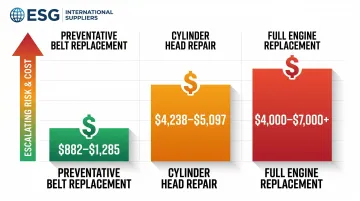
This type of collision damage typically requires a partial or complete engine rebuild. According to repair cost data from RepairPal, cylinder head replacement alone averages $4,238–$5,097, while complete engine replacement ranges from $4,000 to over $7,000 depending on engine size.
Non-Interference Engines: Lower-Risk Design
Non-interference engines are built differently: pistons and valves operate in separate spaces with enough clearance that they never share the same territory. That design gap changes everything when the belt fails.
When the timing belt breaks in a non-interference engine:
- The engine stalls immediately
- Pistons and valves don't occupy the same space
- No collision damage occurs
- The belt still needs replacement, but the engine typically survives intact
The Cost Reality
| Scenario | Cost Range | Source |
|---|---|---|
| Preventative timing belt replacement | $882–$1,285 | RepairPal, 2026 |
| Cylinder head replacement (interference damage) | $4,238–$5,097 | RepairPal, 2026 |
| Complete engine replacement | $4,000–$7,000+ | Family Handyman, 2025 |
Replacing a belt at $882–$1,285 costs roughly one-fifth of what engine damage will run you. That gap makes the replacement decision straightforward.
The Hidden Safety Risk: Losing Power Steering and Brakes Mid-Drive
Engine damage gets most of the attention when a timing belt fails — but the immediate safety hazards are just as serious, and they hit within seconds of the engine stalling.
Loss of Power Steering Assist
When the engine stops, power steering assist disappears instantly. You still have steering control—the mechanical linkage remains intact—but turning the wheel now requires significantly more physical force, especially at lower speeds or when trying to maneuver quickly.
At highway speeds, this surge in required steering effort can make emergency lane changes genuinely difficult — particularly in heavy traffic where there's no margin for slow reactions.
Reduced Brake Assist
Modern vehicles use vacuum-assisted brake systems. The engine's intake manifold generates that vacuum. It powers the brake booster, which multiplies your pedal force. When the engine stalls, vacuum generation ceases immediately.
What happens:
- The brake booster acts as a reservoir, providing one or two power-assisted stops
- After the stored vacuum depletes, brakes remain functional but require dramatically more pedal force
- Federal safety standards (FMVSS 135) require vehicles to stop within specified distances using up to 500 Newtons (112.4 lbs) of pedal force
Most drivers have never applied that much pedal force. If you find yourself in this situation, grip the steering wheel firmly with both hands, press the brake pedal hard and steadily, and steer toward the shoulder rather than attempting lane changes. The systems still work — they just demand more from you.

Warning Signs Your Timing Belt Is About to Fail
Timing belts don't always give you advance notice — but when they do, these are the signs to watch for:
Ticking or Clicking Noise from the Engine
A rhythmic ticking sound—often most noticeable at idle or during acceleration—indicates the belt is losing tension, becoming worn, or struggling to maintain proper rotation. Honda technical service bulletins specifically document timing belt chirps and ticks as wear indicators.
Engine Misfires and Rough Idling
A worn or slipping belt can cause valves to open and close at incorrect intervals, disrupting the combustion cycle. This leads to:
- Rough or uneven idling
- Hesitation during acceleration
- Check engine light activation
- Reduced fuel efficiency
Oil Leaks Near the Front of the Engine
A deteriorating timing belt cover or valve cover gasket can allow oil to seep onto the belt. Once oil contacts the rubber, it accelerates degradation — turning a slow leak into a fast path toward belt failure.
No Warning at All
Timing belts can and do fail without any prior symptoms. Following manufacturer-recommended replacement intervals is your most reliable safeguard — not waiting for warning signs that may never appear.
Typical Replacement Intervals:
| Manufacturer | Recommended Interval |
|---|---|
| Honda/Acura | 60,000–105,000 miles |
| Toyota/Lexus | 60,000–90,000 miles |
| Subaru (EJ engines) | 105,000 miles |
| Ford (certain models) | 100,000–150,000 miles |
Source: Gates Replacement Guide
Check your owner's manual for your specific vehicle's interval. Both mileage and age matter — rubber degrades over time even if you haven't hit the mileage threshold yet.
What to Do If Your Timing Belt Breaks While Driving
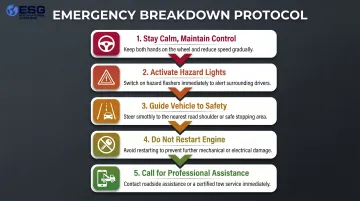
If your engine suddenly cuts out while driving, follow these steps to minimize safety risks:
Step 1: Stay Calm and Maintain Control
- Keep a firm grip on the steering wheel (it will become heavier immediately)
- Don't panic or make sudden steering inputs
- Prepare for increased steering effort
Step 2: Activate Hazard Lights Immediately Turn on your emergency flashers as soon as the engine cuts out. This alerts drivers behind you before you begin losing speed, giving them time to react.
Step 3: Guide the Vehicle to Safety
- Look for the nearest safe stopping point—shoulder, pullover area, or parking lot
- Use your momentum to coast as far as possible
- Press the brake pedal firmly but steadily (remember, it requires more force now)
- Steer smoothly toward your exit path
Step 4: Do NOT Attempt to Restart the Engine Turning the ignition after belt failure can worsen internal damage significantly. Cranking the starter forces the crankshaft to continue spinning while the camshaft remains stationary, actively driving pistons into frozen valves and compounding the damage.
Step 5: Call for Professional Assistance
- Contact roadside assistance or a tow service immediately
- Have the vehicle transported (not driven) to a qualified mechanic
- Request inspection by a technician experienced with engine repair
A qualified technician can assess whether internal components survived intact — that inspection determines whether you're looking at valve and piston repairs or a full engine replacement.
How to Prevent Timing Belt Failure Before It Happens
Prevention is straightforward and dramatically more affordable than repair.
Follow the Manufacturer's Replacement Schedule
Timing belts are wear items with a defined service life. Manufacturers establish replacement intervals based on extensive testing—these aren't suggestions. Whether your belt reaches 60,000, 90,000, or 105,000 miles depends on your specific engine design.
Waiting until symptoms appear is waiting too long. By the time you hear ticking or experience misfires, the belt is already compromised and may fail at any moment.
Schedule Regular Visual Inspections
During routine maintenance, ask your mechanic to visually inspect the timing belt for:
- Cracking or glazing on the belt surface
- Fraying at the edges
- Missing teeth or tooth damage
- Proper tension
- Oil contamination
Replace Associated Components Simultaneously
When replacing the timing belt, automotive engineers and manufacturers strongly recommend simultaneously replacing:
- Water pump (if belt-driven): Internal bearings and seals degrade over the same timeframe
- Tensioner: Ensures proper belt tension and prevents slippage
- Idler pulleys: Worn bearings in these components will destroy a new belt quickly
These components share the same labor costs as the belt replacement. Replacing them together prevents having to pay for the same labor twice when they fail separately 10,000 miles later.
Source Quality Components
Not all timing belts meet the same manufacturing standards. Choosing the right component matters as much as replacing it on schedule.
When evaluating belt quality, look for:
- OEM equivalence: Matches your engine's original tensile strength and tooth profile specifications
- Heat and oil resistance: Rubber compound rated for sustained engine bay temperatures
- Brand traceability: Sourced from manufacturers with documented quality control processes
- Matched kits: Purchasing belt-and-component kits from a single manufacturer ensures consistent tolerances
For industrial operations managing heavy equipment or vehicle fleets, belt sourcing decisions directly affect uptime. ESG International Suppliers distributes industrial power transmission belts — including timing, V-belt, and high torque drive variants — to construction, mining, and power generation operations across North and South America.
Frequently Asked Questions
What happens if the timing belt breaks while you're driving?
The engine shuts off instantly due to loss of crankshaft-camshaft synchronization. In interference engines (most modern vehicles), pistons collide with open valves, causing serious internal damage including bent valves, cracked pistons, and scored cylinder walls.
Will a broken timing belt destroy my engine?
In interference engines—common in most modern vehicles—yes, the collision between pistons and valves typically causes extensive damage requiring a rebuild or replacement costing $4,000–$7,000+. Non-interference engines usually suffer minimal internal damage, requiring only belt replacement.
Are there warning signs before a timing belt breaks?
Warning signs can include ticking noises, misfires, rough idling, and oil leaks near the front of the engine. That said, many belts fail without any prior symptoms — following the manufacturer's replacement schedule is the only reliable safeguard.
How long can you drive with a bad timing belt?
You should not drive at all on a visibly worn, cracking, or noisy timing belt. Continuing to drive risks sudden failure and severe engine damage with no additional warning. If you suspect timing belt problems, have it inspected immediately.
What's the average cost to replace a timing belt?
Preventative replacement averages $882–$1,285 for parts and labor. Engine damage after failure runs $4,238–$5,097 for cylinder head repair or $4,000–$7,000+ for full engine replacement. Prevention costs a fraction of the alternative.
Is it worth fixing a car with a broken timing belt?
It depends on the damage and your vehicle's value. Non-interference engines with no internal damage are usually worth repairing. For interference engines with severe damage, weigh the $4,000–$7,000 repair cost against what the car is actually worth.