
Introduction
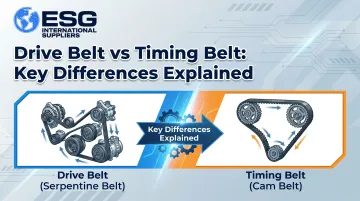
Drive belts and timing belts are both essential engine and machinery components that operators and fleet managers frequently confuse — yet they serve fundamentally different purposes. Mixing them up during maintenance or procurement can trigger equipment failures, catastrophic engine damage, or days of unplanned downtime.
The cost difference is stark: according to industry data, timing belt failure in an interference engine turns a $900 service into a $5,000+ repair, while commercial fleet downtime averages $448 to $760 per vehicle, per day. Choosing the wrong belt — or missing a replacement interval — is the difference between routine maintenance and a full engine rebuild.
For equipment managers in Power Generation, Oil & Gas, Construction, and Mining, this guide breaks down each belt's function, construction, replacement schedules, and failure risks so you can make informed procurement and maintenance decisions.
Key Takeaways
- Drive belts (serpentine belts) transfer power to accessories like pumps, compressors, and cooling fans via friction — smooth or ribbed, no teeth
- Timing belts use toothed engagement to synchronize crankshaft and camshaft rotation — slippage or failure causes immediate engine damage
- Drive belts are external and easier to replace; timing belts sit behind covers and require more complex, costlier servicing
- Both typically last 60,000–100,000 miles, but timing belt replacement carries significantly higher labor costs
- Use drive belts for accessory power transfer; use timing belts where precise internal engine or machinery synchronization is required
Drive Belt vs Timing Belt: Quick Comparison
Both belts keep your engine running — but they fail differently, cost differently, and carry very different consequences when neglected.
| Feature | Drive Belt (Serpentine) | Timing Belt |
|---|---|---|
| Primary Function | Transfers power from crankshaft to external accessories (alternator, AC, power steering pump) | Synchronizes crankshaft and camshaft to control valve timing |
| Design | Smooth or V-ribbed surface; relies on friction; no teeth | Toothed surface that locks into sprocket grooves; prevents slippage |
| Location | External, at front or sides of engine; visible without disassembly | Internal, behind protective timing cover; not visible during routine inspection |
| Lifespan | 60,000–100,000 miles; failure causes accessory loss but engine continues running | 60,000–100,000 miles; failure causes immediate engine cutout and potential catastrophic internal damage |
| Replacement Cost | $80–$150 parts; straightforward shop or DIY replacement | $882–$1,285 average total cost due to high labor requirements; often replaced with water pump and tensioners |
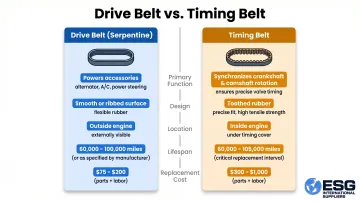
Cost Perspective: A broken serpentine belt on a Class 8 truck can incur $1,500 to $6,000+ in towing and cargo transfer fees, while proactive replacement costs under $150. A failed timing belt in an interference engine can destroy pistons and valves — with engine rebuilds typically running $3,000–$8,000 or more.
What is a Drive Belt?
A drive belt — also called a serpentine belt, accessory belt, or fan belt — is an external rubber belt that runs off the engine's crankshaft pulley and loops around multiple accessory pulleys. Modern vehicles consolidate what used to be several individual belts into one "serpentine" belt, named for its winding route through different components. In 1978, Ford introduced the first multi-ribbed serpentine belt drive system for the 1979 Mustang; today, 99% of cars and light trucks use serpentine belt drives.
Key components powered by a drive belt:
- Alternator — Charges the battery and powers electrical systems
- Air conditioning compressor — Provides cabin cooling
- Power steering pump — Assists steering effort
- Water pump (on some configurations) — Circulates engine coolant
While a drive belt failure is disruptive — causing loss of these systems — the engine itself continues running because the belt is not involved in internal valve timing. However, if the water pump is belt-driven, coolant circulation stops, leading to rapid and potentially damaging engine overheating.
Drive belts feature a smooth or V-ribbed surface and rely on friction (not teeth) to grip pulleys. A belt tensioner maintains appropriate tension. The lack of teeth makes drive belts prone to slipping under heavy loads or when stretched. As little as 5% material loss causes the belt to "bottom out" in the pulley, leading to hydroplaning and accessory slip. Belt type determines how well a drive belt handles a given load environment:
- V-Belts: Trapezoidal profile, used in older vehicles and heavy industrial equipment (compressors, fans, mixers)
- Serpentine/Multi-Rib Belts: Standard in modern automotive and many industrial machines; wide, thin, with multiple longitudinal V-shaped ribs
- Flat Belts: Used in light-duty or industrial conveyor/fan applications
ESG International Suppliers supplies industrial-grade drive belts for demanding applications in Power Generation, Oil & Gas, Construction, and Mining — with product specs matched to high-load operating conditions.
Use Cases of a Drive Belt
In automotive engines, removing the drive belt cuts off the alternator, power steering, and cooling — the engine keeps running but not for long. Fleet operators should inspect drive belts at every major service interval.
In industrial settings, drive belts appear in conveyor systems, HVAC blowers, pumps, fans, crushers, and compressors — anywhere reliable power transfer is needed without strict synchronization requirements. Their ability to absorb shock and tolerate minor shaft misalignments makes them well-suited for heavy-duty environments like mining and construction equipment.
What is a Timing Belt?
A timing belt is a toothed rubber (or polyurethane) belt located inside the engine — hidden behind a protective cover — that connects the crankshaft to the camshaft(s). Its core function: to ensure the engine's intake and exhaust valves open and close at the exact right moment in the combustion cycle, synchronized with piston movement. Without this precise timing, the engine cannot run efficiently — or at all.
Why the Toothed Design is Critical:
The teeth mesh with matching sprocket grooves, preventing any slippage. Even slight timing variation causes misfires, rough running, or — in interference engines — piston-to-valve contact resulting in bent valves or destroyed pistons. This is why a timing belt failure is categorically more serious than a drive belt failure.
Interference vs. Non-Interference Engines:
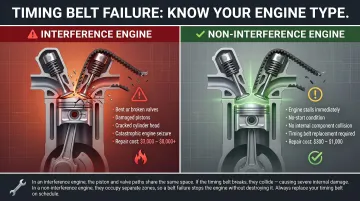
- Interference Engines (approximately 90% of modern vehicles): Pistons and valves share overlapping space within the cylinder. If the timing belt breaks, the camshaft stops but the crankshaft continues spinning due to momentum. The pistons collide with open valves, causing catastrophic damage — bent valves, damaged pistons, cracked cylinder heads.
- Non-Interference Engines: Pistons and valves operate in separate spaces and never overlap. If the belt breaks, the engine stalls and the vehicle won't function, but no internal mechanical collision occurs.
Timing Belt vs. Timing Chain:
Both serve the same synchronization purpose, but timing chains are metal and generally last longer (often the life of the engine) while being noisier and more expensive to replace. Timing belts are quieter, lighter, and less expensive but require scheduled replacement.
Material Composition:
| Application | Belt Material | Tensile Cords | Key Characteristics |
|---|---|---|---|
| Automotive Timing Belts | HNBR (Hydrogenated Nitrile Butadiene Rubber) | Fiberglass or Aramid (Kevlar) | High heat and oil contamination resistance; precise length stability |
| Industrial Synchronous Belts | Polyurethane (PU) | Steel or Aramid | Extreme wear/fatigue resistance; high chemical resistance; zero stretch for precision |
Industrial timing belts use polyurethane for higher resistance to oils, heat, and chemicals — a key requirement in demanding production environments.
Use Cases of a Timing Belt
Timing belts appear in two broad application categories, each with its own performance demands:
- Automotive and Power Equipment Engines: A broken timing belt typically causes the engine to shut off immediately. In interference engines — the majority of modern vehicles — failure can cause immediate catastrophic internal damage worth thousands of dollars in repair costs.
- Industrial Machinery: Timing belts are the preferred choice wherever precise synchronization matters: CNC machines, robotics, packaging lines, printing presses, and aerospace manufacturing equipment. Their zero-slippage design and ability to handle high-speed, high-load cycles with minimal maintenance make them a reliable fit for demanding production environments.
Drive Belt vs Timing Belt: Which One Do You Need?
Key Selection Factors:
- Does the application require precise synchronization of moving parts, or simply reliable power transfer to accessories?
- What are the consequences of belt failure — accessory loss vs. full machine shutdown or mechanical damage?
- What is the maintenance accessibility of the belt location?
- What is the operating environment (temperature, chemical exposure, load variability)?
Situational Guidance:
- Choose a drive belt when: The application involves powering auxiliary components (alternator, pump, fan, compressor) where slight slippage is acceptable and ease of replacement is important.
- Choose a timing belt when: The application demands zero-slip synchronization between rotating shafts — such as engine valve timing, robotic arms, or precision packaging machinery — where any mistiming causes system errors or hardware damage.
Consequence-of-Failure Comparison:
A failed drive belt forces an equipment shutdown but typically doesn't destroy machinery. A failed timing belt — especially in an interference engine or a synchronized industrial machine — can result in extensive mechanical damage, hours or days of unplanned downtime, and repair costs that far exceed the cost of timely belt replacement.
Cost Reality Check
| Scenario | Parts & Labor Cost | Collateral Damage / Downtime | Total Financial Impact |
|---|---|---|---|
| Proactive Timing Belt Replacement | $882–$1,285 (Average) | None (Planned shop time) | $882–$1,285 |
| Reactive Timing Belt Failure | $3,000–$5,000+ (Engine rebuild/replace) | $448–$760/day downtime + Towing fees | $4,000–$8,000+ |
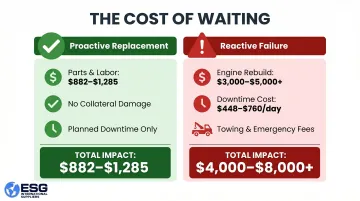
For industrial operations in Oil & Gas, Power Generation, or Construction, this distinction has direct impact on project timelines and budgets.
Real-World Example:
According to Gates, an aggregate mining operation that switched from roller chain drives to a synchronous belt drive system saved $40,450 in parts, labor, and downtime over three years. A sugar mill using the same approach saved $34,000 in its first year alone.
ESG International Suppliers stocks drive belts and timing belts across a wide range of specifications for Oil & Gas, Power Generation, Mining, and Construction applications. To match the right belt to your equipment before the next maintenance window, contact the ESG team at 516-787-5679 or support@esg_intl.com.
Conclusion
Drive belts and timing belts are not interchangeable — they solve different problems in an engine or machine. The drive belt keeps accessories running; the timing belt keeps the engine (or machine) alive. Understanding this distinction allows maintenance managers, fleet operators, and industrial procurement teams to make informed sourcing decisions, schedule replacements proactively, and avoid the operational and financial consequences of belt failure.
For industrial operators, choosing the correct belt type and replacing it on schedule has direct operational consequences. Getting this right means:
- Fewer unplanned stoppages interrupting production schedules
- Protected equipment investment through proactive rather than reactive maintenance
- Sustained efficiency across demanding environments in mining, construction, oil and gas, and power generation
Frequently Asked Questions
Is a timing belt the same as a drive belt?
No, they are not the same. A drive belt (serpentine belt) powers engine accessories using friction and a smooth or ribbed surface, while a timing belt uses toothed engagement to synchronize the crankshaft and camshaft internally. They perform different functions and are not interchangeable.
When should a drive belt be replaced?
Most drive belts need replacement every 60,000–100,000 miles, though intervals vary by make and model. Visible cracking, fraying, glazing, or squealing are signs replacement is needed sooner. Modern EPDM belts wear down like tire tread without showing cracks — use rib-profile gauges to check groove depth rather than relying on visual inspection alone.
Can I drive if my timing belt is bad?
Driving with a failing timing belt is extremely risky. If it breaks while driving, the engine will immediately shut off and, in interference engines (90% of modern vehicles), can cause severe internal damage including bent valves and damaged pistons, resulting in costly repairs or engine replacement totaling $3,000–$5,000+.
Is replacing a timing belt a big job?
Yes, timing belt replacement is more involved than a drive belt swap. It requires accessing the internal engine, removing covers, and reinstalling the belt with precise tension and alignment — typically 3 to 6 hours of labor. Replacing the water pump and tensioners at the same time avoids duplicate labor costs down the road.
What's the average cost to replace a timing belt?
According to RepairPal, timing belt replacement averages $882–$1,285 in the United States — parts run $297–$428, while labor accounts for $584–$858. Costs vary by vehicle make and model, so get a model-specific estimate before budgeting.
What are the signs of a failing drive belt or timing belt?
Drive Belt Warning Signs:
- Squealing or chirping noise indicating belt slippage
- Visible cracking, fraying, or glazed surface
- Loss of AC cooling or stiff power steering
- Dead battery or dimming headlights (alternator not charging)
Timing Belt Warning Signs:
- Engine misfires or rough idle due to altered valve timing
- Ticking or rattling noise from the front of the engine
- Oil leaks near the timing cover area
- Engine won't turn over or starts sounding faster than normal