
Introduction
Mining is one of the most equipment-intensive industries in the world. Machines operate under constant impact, abrasion, and pressure from some of the hardest raw materials on earth—granite, iron ore, copper-bearing rock—making wear damage a daily operational cost, not a rare event.
Wear plates are widely used across mining operations, yet their value is often underestimated until a critical component fails. The real cost shows up in downtime, replacement cycles, and lost throughput.
Maintenance costs in mining commonly consume 30% to 50% of total operating costs, and unplanned downtime can run between $100,000 and $500,000 per hour depending on the operation's scale.
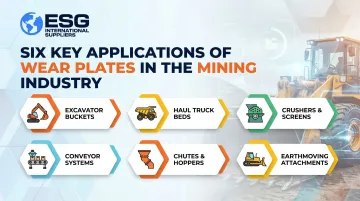
This article breaks down the six most important places wear plates are applied in mining, what they protect, and why it matters operationally.
Key Takeaways
- Wear plates are sacrificial protective liners that absorb abrasion and impact instead of expensive base equipment
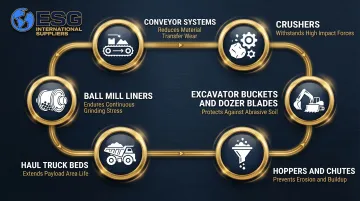
- Six key mining applications: conveyor systems, crushers, excavator/loader buckets and dozer blades, hoppers and chutes, haul truck beds, and ball mill liners
- Each application has distinct wear patterns requiring specific plate grades (AR400, AR500, chromium carbide overlay)
- Ignoring wear plate maintenance triggers unplanned shutdowns, accelerated equipment degradation, and escalating repair costs
- Matching the right plate grade to each application — with reliable supply behind it — is what keeps equipment running between planned maintenance cycles
What Are Wear Plates and Why Do They Matter in Mining?
Wear plates are hardened steel or composite plates installed as a sacrificial layer on equipment surfaces that face direct contact with abrasive rock, ore, and minerals. The plate wears down so the expensive component beneath doesn't.
Material categories include:
- Abrasion-resistant (AR) steel — Grades like AR400 (360–444 HBW), AR450 (430–480 HBW), and AR500 (477–534 HBW) rated by Brinell hardness
- Chromium carbide overlay (CCO) — Features 55–64 HRC surface hardness with chromium carbides reaching 1700 HK, deposited on mild steel base
- Composite materials — Embed tungsten carbide or ceramic elements in a steel matrix, targeting specific failure modes such as fine-particle erosion or combined impact-abrasion
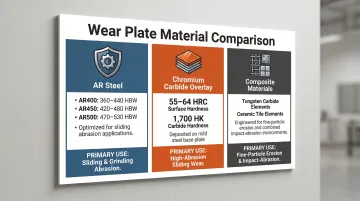
Material choice is driven by whether the primary threat is sliding abrasion, high-impact force, or both. In high-tonnage mining environments, selecting the right wear plate grade directly determines how long equipment stays in service between shutdowns—and how much unplanned downtime costs the operation.
Six Key Applications of Wear Plates in the Mining Industry
The six applications below represent the highest-wear contact points in typical mining operations. Each has unique stress conditions that determine the right plate specification and replacement frequency.
Application 1: Conveyor Systems
Conveyor systems run continuously—often 24/7—and form the backbone of ore transport across every stage of a mining operation. Belt skirt boards, pan liners, and transfer points take constant abrasive punishment from moving ore and rock at high relative speeds.
Wear plates applied as skirt liners and pan liners take the wear load directly, allowing operators to swap out worn sections without shutting down the entire conveyor line or replacing structural components. In one iron ore operation processing 5,000 tons per hour, composite skirt liners lasted six times longer than white iron wear plates—183 days versus just 30 days.
KPIs impacted and when it matters most:
- Conveyor uptime
- Spillage rate
- Cost-per-ton of material moved
A single conveyor belt failure at one of the world's largest mines can cost between $6 million and $12 million. In high-tonnage operations, even short unplanned shutdowns cascade into significant production losses, with operations running near capacity losing $50,000 to $100,000 per day when primary conveyors go offline.
Application 2: Crushers
Crushers handle the first and most violent stage of ore reduction. Jaw plates, cheek plates, and interior liners are exposed to enormous compressive and impact forces from boulders weighing hundreds of kilograms.
Abrasion-resistant liner plates distributed across crusher walls and high-impact zones extend intervals between rebuilds, keeping the crusher processing material rather than undergoing maintenance. In highly abrasive quartz applications, standard Mn13 steel fails (60-100 hours), while upgrading to Mn18Cr2 or tungsten-carbide inserts extends replacement intervals by 2x to 4x.
KPIs impacted and when it matters most:
- Crusher availability rate
- Throughput per hour
- Liner replacement frequency
Primary crushing circuit designs typically target 75% availability as a baseline. Unplanned downtime in mining costs an average of $180,000 per incident, which makes crusher availability a direct driver of production output at high-capacity mines.
Application 3: Excavator/Loader Buckets and Dozer Blades
Buckets and blades are in constant aggressive contact with the ground and rock face. The cutting edge, floor, and sidewalls of excavator and loader buckets face combined impact and abrasion with every dig cycle, while dozer blades face continuous sliding abrasion against compacted earth and rock.
Wear plates applied as bucket floor liners, side liners, and blade overlays significantly extend the working life of earthmoving attachments. In a South African mine, applying chromium carbide overlay to excavator bucket teeth resulted in a 3x longer service life compared to original CrMo steel teeth. An electric shovel in an open-pit copper mine increased service life by 56% when using a CCO liner package compared to AR 600 liners.
KPIs impacted and when it matters most:
- Bucket replacement cycle time
- Fuel efficiency (lighter wear-plated buckets vs. heavier rebuilt buckets)
- Site safety
In open-pit mining, equipment cycles are relentless and bucket failures carry real safety consequences. MSHA documented a fatal accident in 2004 where two workers were killed when a 16,770-pound shovel dipper door fell after a welded cutting edge blade failed.
Application 4: Hoppers and Chutes
Hoppers and chutes are gravitational transfer points where raw material is dropped, funneled, and redirected at high velocity. The combination of impact from falling material and sliding abrasion from ore movement creates aggressive wear at specific impact zones and flow surfaces.
Wear plates lining hopper walls and chute surfaces protect structural steel from concentrated wear patterns that develop at drop points and bends. In one active iron ore transfer chute handling 1,800 tonnes per hour, 75mm thick NiHard 4 white cast iron blocks wore out within two weeks. Using chromium carbide wear plates in a crusher chute at a gold mine resulted in a 525% increase in wear plate life—from 8 weeks to 42 weeks.
KPIs impacted and when it matters most:
- Parts replacement frequency
- Material spillage rates
- Structural integrity of the transfer system
Operations handling coarse, high-density ores like iron ore or copper face the harshest conditions here—the impact load per ton accelerates wear at every transfer point.
Application 5: Haul Truck Beds
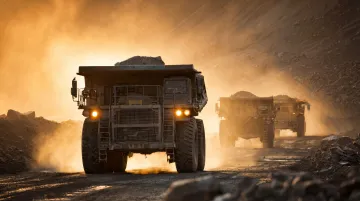
Haul trucks in mining face a double wear threat: severe impact from rock being loaded at the dump point, and aggressive abrasion as material slides across the bed floor during transport and tipping. Without protection, truck bed floors thin out rapidly and require costly structural repairs.
Wear plate liners in truck beds absorb impact from loading and reduce surface abrasion, extending the operating life of the bed. Thinner, high-performance wear plates reduce carry-back weight compared to full steel replacement. In one case study, using a lighter rubber/steel hybrid truck body lining allowed for a 7.9% increased payload per haul—an additional 7,187 kg on a CAT 777G.
KPIs impacted and when it matters most:
- Truck bed service life
- Payload weight efficiency
- Tire replacement cost
- Fuel consumption
Relining the bed of a mining-class haul truck typically requires one to two weeks of downtime. For a fleet of 20 trucks, that represents 20 to 40 weeks of cumulative maintenance time across the fleet.
In large-scale open-pit mines where fleets operate continuously, any reduction in payload capacity or fuel efficiency compounds across hundreds of cycles per day—making liner longevity a fleet-wide cost issue, not just a per-truck one.
Application 6: Ball Mill Liners
Ball mills grind ore by tumbling it with steel grinding balls inside a rotating drum. Interior liner surfaces face relentless abrasion from both the ore and the balls themselves, creating one of the most severe wear environments in the entire mineral processing circuit.
High-hardness wear plates used as mill liners resist the combined grinding and impact forces inside the drum, extending liner change-out intervals and maintaining mill geometry for consistent grinding performance. The typical service life of mining ball mill liners is about 8 months, with complete liner replacement requiring 24 to 48 hours of downtime.
KPIs impacted and when it matters most:
- Mill throughput
- Liner change-out frequency (requires full mill shutdown)
- Grind consistency
Mill relining represents between 2% and 5% of lost annual mill production. In a large copper SAG mill, 1% downtime equates to $13.1 million in lost processing capacity annually, based on a metric of $150,000 per hour for contained metal value. This is critical in any operation with downstream flotation or leaching processes where particle size distribution directly affects recovery rates.
What Happens When Wear Plates Are Ignored or Neglected
Skipping wear plate maintenance shifts damage from a replaceable liner to the structural component beneath. What starts as a planned swap becomes an unplanned structural rebuild — far more expensive and far harder to schedule around active operations.
Without proper wear protection, the consequences compound quickly:
- Unprotected components fail without warning, halting production lines mid-shift
- Downstream processing disruptions ripple through the entire operation
- Structural failure and material spillage create serious safety exposure
- Minor wear issues left unaddressed accelerate into major asset degradation
The financial impact is direct. Emergency repair costs run 300% to 500% higher than planned maintenance. Planned work typically consumes about one-third of the labor, materials, and downtime that reactive work demands. Waiting until a wear plate fails completely exposes the underlying structure to damage — adding repair costs that dwarf the original plate replacement.
How to Get the Most Value from Your Wear Plates
Wear plate effectiveness depends on matching the right material grade to the right application. AR400 may be sufficient for moderate sliding wear on a truck bed, while a chromium carbide overlay or composite plate may be necessary for the high-impact zones of a crusher or ball mill. Using the wrong grade leaves performance and lifespan on the table.
Replacement scheduling matters as much as material selection. Wear plates should be inspected at regular intervals and replaced proactively before they reach structural failure, not reactively after damage has already progressed to the base component. Establishing thickness benchmarks and inspection intervals per application creates a predictable maintenance rhythm. For example, jaw plates should be replaced when total thickness diminishes to approximately 25–50mm, or when deep wear grooves exceed 15–20% of the plate thickness.
Sourcing from a supplier with deep product knowledge also reduces the risk of incorrect grade selection and supply delays. ESG International Suppliers stocks wear plates across a wide material range — steel, aluminum, copper, titanium, and tungsten — and offers product guidance for mining applications throughout North and South America. Having a reliable supply partner in place keeps replacement schedules on track and unplanned downtime off the table.
Frequently Asked Questions
What are wear plates used for in mining?
Wear plates are installed on high-contact surfaces in mining equipment—such as crushers, conveyors, chutes, buckets, and mill liners—to absorb abrasion and impact damage in place of structural components beneath, extending equipment lifespan and reducing maintenance costs.
What are the different types of wear plates?
Main categories include abrasion-resistant (AR) steel plates (such as AR400 and AR500), chromium carbide overlay (CCO) plates, and composite wear plates. Each is suited to different combinations of sliding abrasion, impact force, and operating temperature requirements.
What is the difference between wear plate and Hardox plate?
Hardox is a brand name for a specific line of through-hardened abrasion-resistant steel wear plates manufactured by SSAB, while "wear plate" is the general category. All Hardox plates are wear plates, but not all wear plates are Hardox.
What steel is used for wear plates?
Most mining wear plates are made from high-carbon abrasion-resistant steel (AR grades rated by Brinell hardness), chromium carbide overlay alloys deposited on a mild steel base, or composite materials combining carbide elements in a steel matrix. The choice depends on the specific wear mechanism in each application.
What is Hardox 450 used for?
Hardox 450 is a mid-range abrasion-resistant steel plate with approximately 450 Brinell hardness (guaranteed range 425–475 HBW). It's commonly used in mining applications like truck bodies, excavator buckets, and chute liners where both abrasion resistance and some degree of formability and weldability are needed.
How do I know when to replace wear plates on mining equipment?
Inspect wear plates at regular intervals using thickness measurement tools, and replace them before they reach the base material. Visible cracking, deformation, or material breakthrough means replacement is overdue and structural damage may already be occurring.