
Introduction
Reusing a compression fitting after disassembly is one of those maintenance decisions where getting it wrong costs far more than the fitting itself. Whether it's safe depends on the fitting's condition, the application, and which components you're working with.
Across industrial facilities — from hydraulic systems to high-pressure process lines — a failed reused fitting can mean unplanned downtime, leaks, or a safety incident. Knowing when reuse is acceptable and when replacement is the only option is a practical skill.
This guide covers how compression fittings work, what determines reusability, and how to safely reinstall them in industrial environments where connection integrity isn't negotiable.
TLDR: Quick Answers for Busy Professionals
- Fitting bodies and nuts are often reusable if undamaged, but the ferrule (olive) typically requires replacement
- Reuse on the same pipe where the ferrule originally sealed is safer than moving to new tubing
- Replace ferrules for gas lines, high-pressure systems, and concealed installations—the cost of a new fitting is negligible compared to failure risk
- Inspect threads, ferrule deformation, and material condition before any reuse decision
- Pressure-test all reassembled fittings before putting systems back in service
How Compression Fittings Work (And Why Reuse Is Complicated)
The Three-Component Sealing System
Compression fittings consist of three parts working together to form a seal:
- Compression nut — tightens to drive the ferrule into position
- Ferrule (also called an olive or sleeve) — deforms under compression to create the actual seal
- Fitting body — houses the tapered seat that the ferrule wedges against
When you tighten the nut, it forces the ferrule to compress against the pipe's outer diameter while simultaneously wedging into the fitting body's tapered seat. This creates a metal-to-metal seal through controlled deformation, with no adhesives, sealants, or heat required.
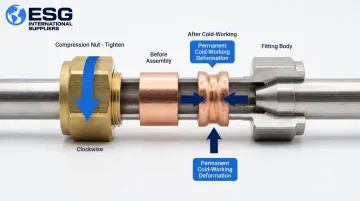
The ferrule undergoes permanent cold-working during installation. As the nut tightens, the ferrule bites into the tubing surface, creating circumferential grooves while deforming to match the exact geometry of both the pipe and the fitting body's internal taper.
Why Reuse Gets Complicated
The sealing mechanism depends entirely on the ferrule's ability to deform precisely to match the pipe surface. Once that deformation occurs, the ferrule has permanently changed shape. Move it to a different pipe — even one of the same nominal size — and the geometry won't match. Those grooves and that deformed profile were formed against one specific pipe's diameter, surface finish, and minor irregularities.
This differs from push-fit fittings (which use replaceable O-rings) or threaded pipe joints (which rely on thread sealant). Those systems reset easily; compression fittings don't. The ferrule's permanent deformation is what makes reuse decisions — and ferrule condition — so consequential.
Can You Reuse a Compression Fitting? The Direct Answer
Yes, but with significant conditions. The fitting body and nut can typically be reused if they're undamaged. The ferrule is where risk concentrates, and reusability varies by material, application pressure, and whether you're reinstalling on the same pipe or new tubing.
Same Pipe vs. New Pipe: The Critical Distinction
Reinstalling a fitting on the same pipe section it came from carries far less risk. The ferrule's existing grooves still align with the marks it made during initial installation, and the deformed geometry matches the pipe's surface.
Moving a used fitting to new tubing is where problems emerge. The ferrule won't match the new pipe's surface, the bite-in grooves won't align, and the compression geometry becomes unpredictable. Manufacturers including Swagelok, Parker, and Ham-Let permit multiple reassemblies only if the ferrule remains on the original tubing.
Reusability by Material
Material determines how many times a fitting can safely be reassembled — and whether the ferrule survives at all:
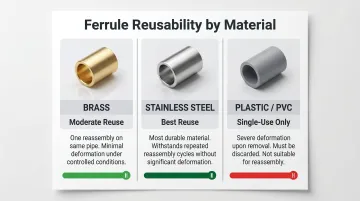
- Brass: Best reuse potential. Hard material resists corrosion, and ferrules can typically survive one reassembly on the same pipe with minimal deformation.
- Stainless steel: Most durable option for industrial environments. Withstands repeated assembly cycles better than softer metals, though ferrule deformation is still permanent.
- Plastic / PVC: Single-use only. Softer material deforms severely during initial installation; discard the ferrule and sleeve upon disassembly.
The Ferrule Replacement Approach
Replacing only the ferrule while reusing the body and nut is the safest and most cost-effective approach. The fitting body retains the highest value and doesn't deform during standard installation. Manufacturers explicitly recommend this: purchase inexpensive replacement ferrule sets and salvage the more expensive fitting bodies.
Always check the manufacturer's documentation. Some fittings are marked "single-use" while others permit reuse with ferrule replacement, depending on the brand and applicable standards like BS EN 1254 for European copper tube compression fittings.
The Ferrule: The Component That Decides Everything
Why the Ferrule Is Decisive
The ferrule is the only component designed to undergo intentional permanent deformation. Its entire function is to bite into and grip the pipe surface—it is consumed by the sealing process. Once released from the tubing, metal ferrules no longer maintain their original dimensions. Microscopic fractures can occur during initial tightening, expanding with repeated use and compromising the seal.
Inspection Criteria
Before reusing any ferrule, inspect for:
- Deep circumferential grooves from pipe bite-in
- Flat spots or out-of-round shape indicating excessive deformation
- Cracks, splitting, or material fatigue
- Pitting, corrosion, or surface degradation
- Improper insertion depth (front edge should align with the tube end)
Any of these conditions means the ferrule should be replaced, not reused.
Ferrule Behavior by Material
| Material | Reuse Tolerance | Notes |
|---|---|---|
| Brass | Moderate | Can often be reused once on the same pipe if deformation is minimal and inspection passes |
| Copper | Low | Softer material makes over-deformation more likely; replace rather than reuse |
| Plastic / Nylon | None | Single-use only — softer material does not recover from compression |
The Cost Case for Replacement
Ferrules are inexpensive consumables. A replacement ferrule set costs a fraction of a complete fitting assembly, and far less than the cost of a leak-related system failure. Replacing the ferrule while reusing the body and nut is the professional standard in both plumbing and industrial maintenance.
Consequences of Reusing Damaged Ferrules
That cost calculation matters most when you consider the alternative. A deformed or damaged ferrule creates misaligned compression, uneven stress on the pipe wall, and micro-leaks that worsen under pressure cycling. In hydraulic or gas applications, this can escalate to sudden connection failure under load.
When Reuse Is Safe vs. When to Always Replace
Acceptable Reuse Scenarios
Reuse is appropriate when:
- Low-pressure water supply lines in household or light commercial applications
- Temporary installations or test setups where connections may need adjustment
- Reinstalling on the exact same pipe the fitting was removed from
- Replacing the ferrule even while reusing the body and nut
- Easy accessibility where leaks can be immediately detected and repaired
Do Not Reuse: High-Risk Situations
Never reuse compression fittings in:
- Gas lines — including low-pressure residential natural gas, where even minor leaks pose ignition risk
- Hydraulic systems operating above moderate pressures
- Steam lines where temperature cycling accelerates material fatigue
- Chemically aggressive fluid systems where corrosion compromises ferrule integrity
- Concealed installations — inside walls, floors, or underground — where a failed connection cannot be inspected or caught early
Regulatory and Code Requirements
The International Fuel Gas Code (IFGC) Section 403.10.4 requires that compression-type tubing fittings be used within the manufacturer's pressure-temperature recommendations and service conditions. Local plumbing and building codes in many jurisdictions explicitly prohibit reusing compression fitting ferrules on gas lines and high-pressure systems. ASME B31.3 (Process Piping) permits flareless compression fittings provided they're compatible with the tubing and safeguarded under severe cyclic conditions.
Always verify applicable codes for your specific installation before proceeding.
The Decision Prompt
If there is any doubt about ferrule condition, application pressure, or code compliance—replace the fitting. The cost of a new compression fitting is negligible compared to the liability, downtime, or safety risk of a failed connection in critical industrial systems.
How to Safely Reuse a Compression Fitting: Step-by-Step
Proper Removal Technique
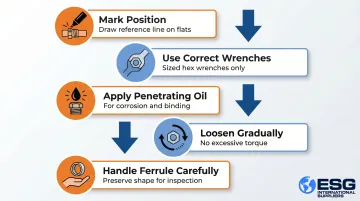
- Mark the fitting position before disassembly—draw a line along the nut and fitting body flats with a permanent marker
- Use correctly sized wrenches (not adjustable pliers) to avoid distorting the nut's hex flats
- Apply penetrating oil if corrosion or thread binding is encountered, and allow time to penetrate
- Loosen gradually without forcing—excessive torque can damage threads or crack the fitting body
- Handle the ferrule carefully during disassembly to preserve its shape for inspection
Cleaning and Inspection
Clean all components with mild detergent and a soft brush, rinse thoroughly, and dry completely before inspection.
Inspect systematically:
- Check nut threads for stripping, cross-threading, or galling
- Examine the fitting body for cracks, corrosion, or internal debris buildup
- Inspect the ferrule for deformation — grooves, flat spots, cracks, or pitting
Replace any component that fails inspection. Attempting to reuse damaged components risks system failure.
Reassembly and Tightening
- Reinstall components in correct order: Slip the nut onto the pipe, then the ferrule, before inserting into the fitting body
- Hand-tighten first until the ferrule seats against the fitting body and resistance increases
- Tighten to the marked position using a wrench — the reference line you drew during disassembly is your target
- Advance 10°–20° past the marked position (less than one-third of a hex flat) — resistance increases noticeably as the ferrule re-seats into sealing position
- Do not over-tighten: Excessive force can crack fittings, deform pipes, or cause thread galling
Pressure Testing
Always pressure-test before returning the system to service. ASME B31.3 specifies the following minimums for metallic piping systems:
- Hydrostatic test: At least 1.5× design pressure
- Pneumatic test: 1.2–1.5× design pressure
Inspect all connections during the test for leaks, and recheck after the system has been at pressure for at least 10 minutes.
Risks of Reusing Compression Fittings in Industrial Applications
Why Stakes Are Higher in Industrial Contexts
In Oil & Gas, Mining, or Hydraulic Power systems, a leaking compression fitting isn't just a maintenance inconvenience. It can mean fluid contamination, unplanned system downtime, environmental incidents, or direct safety hazards to personnel. The consequences scale dramatically compared to residential plumbing.
Failure Modes from Improper Reuse
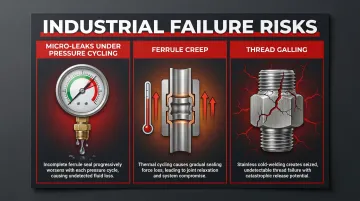
Micro-leaks under pressure cycling: A ferrule that doesn't seal completely may hold at static pressure but weep fluid as the system cycles through pressure fluctuations. These leaks worsen with each pressure cycle.
Ferrule creep: Repeated thermal expansion and contraction can cause the ferrule to gradually lose sealing force, especially if it was already deformed from previous use.
Thread galling: Repeated assembly-disassembly cycles on stainless steel fittings can cause thread surfaces to cold-weld and tear, leading to fitting failure that may not be detectable until the connection fails under load.
Real-World Failure Examples
The NTSB investigated a 2021 engine room fire aboard the containership President Eisenhower. A crewmember insufficiently swaged a compression fitting ferrule on fuel oil return tubing. The tubing disconnected, spraying fuel onto an unshielded exhaust component and igniting a fire.
That incident wasn't isolated. In 2000, seven Los Alamos National Laboratory employees suffered radiation uptake when a pressurized tube broke loose from an improperly installed compression fitting that had been hand-tightened only — meaning ferrules never engaged the tube. A subsequent audit found 49% of 16,505 checked fittings needed tightening.
The Economic Argument
A replacement compression fitting costs between $5 and $50 depending on size and material. A leak-related shutdown in a production or extraction environment can cost thousands to tens of thousands per hour in lost production, emergency repairs, and potential safety investigations.
When a $20 fitting can prevent a five-figure shutdown, the math isn't complicated — replace it.
Frequently Asked Questions
Can you reuse a compression fitting?
Yes, the fitting body and nut can often be reused if undamaged, but the ferrule should ideally be replaced. Reuse is application-dependent—gas lines and high-pressure systems generally require full replacement, while low-pressure water lines may permit careful reuse on the same pipe.
Can you re-tighten a compression fitting?
Re-tightening can temporarily address a slow leak but isn't a reliable long-term fix. Over-tightening risks cracking the fitting or deforming the pipe. When a leak returns after re-tightening, inspect the ferrule and replace the connection.
How long do compression fittings last?
Well-installed brass or stainless steel compression fittings can last decades in stable conditions. Lifespan is shortened by high pressure, temperature cycling, chemical exposure, and repeated disassembly.
Are compression fittings as good as solder?
Compression fittings offer comparable reliability in most plumbing applications and are preferred where heat cannot be used. Soldered joints may be more appropriate in high-vibration or permanent high-pressure installations where the ferrule's mechanical seal could be stressed over time.
What are common compression fitting mistakes?
The most frequent errors include over-tightening (which cracks fittings or deforms pipes), under-tightening (causing slow leaks), not inserting the pipe fully into the body before tightening, and reusing a deformed ferrule on a new pipe section.
Do you use Teflon tape on brass compression fittings?
PTFE tape is not required on compression fittings because the seal is created mechanically by the ferrule, not by the threads. Some technicians apply a small amount to the nut threads to prevent thread galling — this is harmless if used sparingly, but never apply it to the ferrule or sealing surfaces.