Introduction
Compression fittings are a go-to mechanical joining method across plumbing, construction, oil & gas, and industrial fluid systems—valued because installation requires no heat, no solvents, and no special tools. Unlike soldered or fused joints, compression fittings can be assembled in confined spaces, under open-flame restrictions, and in field conditions where both speed and access are limited.
Plastic pipe, however, introduces a compatibility variable that metal pipe doesn't. Wall rigidity, pipe softness, and material type all affect whether the seal holds or fails. Most leaks trace back to mismatched fittings or skipped installation steps—not defective parts. In most cases, that missing component is the internal pipe insert.
This guide covers correct installation of compression fittings on plastic pipe in real-world conditions—including compatibility, required materials, step-by-step process, and the failure points professionals encounter most.
Key Takeaways
- Compression fittings work on PVC, CPVC, PE, and PEX — unreinforced soft tubing is not compatible
- Always use a pipe insert with flexible plastics like PE and PEX to prevent wall collapse under ferrule compression
- Tighten to hand-tight plus 1–1.5 wrench turns only—over-tightening deforms the ferrule and creates leaks
- Use brass fittings for pressure lines and all-plastic compression fittings for drain and waste applications
- Pressure-test before putting the system into service
When Should You Use Compression Fittings on Plastic Pipe?
Ideal Applications
Compression fittings are the right call when heat or chemical bonding isn't practical. Use them for:
- No-flame zones where soldering or heat fusion poses fire risk
- Confined spaces where torch access is restricted
- Field repair conditions requiring fast, tool-light assembly
- Future-access joints such as service valves, cleanout traps, and branch isolation points
Where They're Commonly Misused
Compression fittings don't replace bonded joints in every situation. Avoid them in:
- Lines exceeding the plastic pipe's rated temperature or pressure
- Ultra-soft flexible tubing without inserts
- Applications where project specifications explicitly require permanent bonded or soldered joints
Industry Context
This combination appears frequently in:
- Light industrial process piping in utility and manufacturing facilities
- Non-critical branch connections in oil & gas, mining, and power generation
- Construction site water supply
- Residential and commercial drain/waste lines (larger plastic compression fittings)
Of these sectors, gas distribution carries the most specific regulatory requirements. The U.S. Department of Transportation (DOT) permits compression-type mechanical joints on plastic pipe under 49 CFR 192.281, provided they meet Category 1 specifications — meaning the fitting delivers both a leak-tight seal and pullout resistance equal to or greater than the pipe's yield strength.
Plastic Pipe Compatibility: What Works and What Doesn't
The Core Principle
Compression fittings rely on the pipe wall resisting the inward force of the ferrule to create a seal. If the wall collapses or deforms away from the ferrule, both grip and seal are lost. This is why rigid pipe seals reliably while soft tubing requires reinforcement.
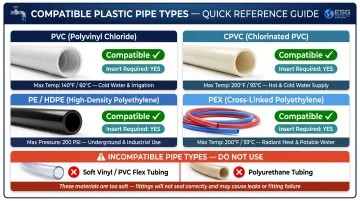
PVC (Polyvinyl Chloride)
PVC's rigid walls resist ferrule compression effectively, making it one of the more reliable plastic pipe options. Two requirements apply:
- Internal pipe insert required — prevents the nut from crushing the pipe end during tightening, even with brass fittings
- Temperature limit: 140°F (60°C) — at this threshold, pressure ratings drop to just 22% of the base rating at 73°F
CPVC (Chlorinated Polyvinyl Chloride)
CPVC shares PVC's rigidity but handles higher temperatures — making compression fittings especially practical for repair joints where solvent welding into an existing line isn't feasible.
Temperature derating to keep in mind:
- At 140°F: pressure derates to 50% of base rating
- At 200°F (93°C max): pressure derates to 20% of base rating
Polyethylene (PE/HDPE)
PE works well with compression fittings — but only with a pipe insert installed. Federal regulation 49 CFR 192.281 explicitly mandates a rigid internal tubular stiffener: without it, the soft wall deflects inward and the ferrule loses its bite.
This combination is widely used in construction site water supply lines and underground industrial water distribution.
PEX (Cross-Linked Polyethylene)
PEX delivers good mechanical grip when correctly sized. Like PE, it requires an internal pipe insert. A few application-specific details apply:
- Verify OD carefully — PEX sizing conventions vary between manufacturers, so confirm fitting dimensions against the specific pipe spec
- Lead-free brass required — NSF/ANSI 372 certification (≤0.25% lead content) is mandatory in most North American jurisdictions for potable water service
What Does Not Work Reliably
Incompatible without modification:
- Soft vinyl tubing
- Polyurethane tubing
- Any thin-walled flexible plastic tubing
Why: Without reinforcement, wall collapse under ferrule compression negates both holding force and seal. A rigid tubing insert must be pressed into the pipe end first.
What You Need Before Getting Started
Components Required
| Component | Purpose |
|---|---|
| Compression nut | Applies tightening force to compress ferrule |
| Ferrule (compression ring) | Primary sealing element—deforms under compression to create line contact with pipe OD |
| Fitting body | Structural anchor and seating surface |
| Pipe insert/stiffener (for soft plastics) | Maintains pipe wall rigidity under ferrule load |
Important: Mixing components from different manufacturers is not recommended. Ferrule taper angles and thread pitch vary between brands and can produce unreliable seals.
Tools Needed
- Pipe cutter — produces a clean, square cut (saws leave ragged edges that prevent full seating)
- Deburring or chamfering tool — removes edge burrs that can damage the ferrule during insertion
- Adjustable wrench
- Measuring tape
Installation requires hand tools only — no heat source, adhesive, or power equipment.
Pre-Installation Checklist
Before selecting fittings, verify:
- Pipe material and wall thickness
- Fitting's pressure rating meets or exceeds system operating pressure
- Lead-free certified brass required for potable water (NSF/ANSI 372 compliance in North America)
How to Install Compression Fittings on Plastic Pipe
Correct installation follows a defined sequence. Most leak failures trace to one skipped or reversed step—not defective parts.
Setup and Preparation
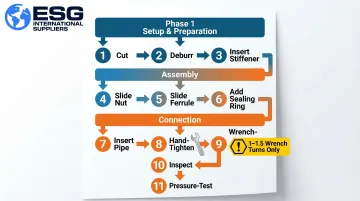
1. Make a clean, square cut
Use a pipe cutter at the marked measurement. A squared end allows the pipe to seat fully against the internal stop in the fitting body. An angled or ragged cut creates a gap the ferrule cannot seal.
2. Deburr and chamfer
After cutting, deburr the pipe end inside and out. Apply a light chamfer to the outer edge to ease ferrule seating.
3. Insert the pipe stiffener (if required)
If working with PE, PEX, or other flexible-wall plastic pipe, press the pipe insert/stiffener fully into the pipe end before proceeding. Confirm it is flush with the pipe end and has not collapsed the pipe wall during insertion.
Assembling onto the Pipe
4. Slide the compression nut onto the pipe first
The threaded end must face outward toward the fitting body.
5. Slide the ferrule over the pipe
If the ferrule is asymmetrical (cone-shaped), the tapered or narrow end must face toward the fitting body. Reversing the ferrule is one of the most common assembly errors and produces an immediate leak.
6. Add sealing ring (if included)
If the fitting includes a separate rubber sealing ring (common on larger plastic drain fittings), slide it on next with the tapered edge facing toward the join.
Making and Tightening the Connection
7. Fully insert the pipe
Push the prepared pipe end fully into the fitting body until it contacts the internal stop. Partial insertion means the ferrule will compress in the wrong position and the pipe can pull out under pressure.
8. Hand-tighten the nut
Thread the compression nut onto the fitting body by hand and confirm it is not cross-threaded before advancing further.
9. Wrench-tighten using controlled rotation
Once hand-tight, use an adjustable wrench for 1 to 1.5 additional turns only.
- Swagelok specifies 1¼ turns for sizes ¼" to 1"
- Dixon specifies 2 full turns for thermoplastic tubing ¼" through ¾"
Critical: Tightening is controlled by nut rotation, not torque feel. Over-tightening deforms the ferrule into surface contact rather than line contact, which weakens the seal.
Verifying the Connection
10. Visual inspection
Before pressurizing, check for proper alignment, absence of cross-threading, and that the nut is seated flush.
11. Pressure test
Pressurize the line to operating pressure and check for moisture or pressure drop. Visible ferrule deformation at the nut face indicates over-tightening.
Best Practices for Leak-Free Performance
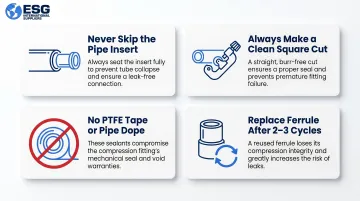
Never Omit the Pipe Insert
This is the single most frequently skipped step and the leading cause of compression fitting failures on plastic pipe. Even if the connection appears to hold initially, the pipe wall will continue to deflect under sustained pressure until the seal loosens.
Insert supports are required for any pipe with wall flexibility. Always use one with:
- PE and PEX
- CPVC in high-pressure applications
- Any plastic with moderate wall flexibility
Clean, Square Cuts Are Non-Negotiable
Even a slightly angled pipe end prevents full seating in the fitting body, creating a partial seal that leaks under fluctuating pressure or thermal expansion. Before assembly:
- Deburr the cut edge to remove burrs that score the ferrule
- Chamfer the pipe end to ease insertion without disturbing the bore
Do Not Apply PTFE Tape or Pipe Dope
The seal is entirely mechanical, created by ferrule-to-pipe and ferrule-to-body contact. Thread sealants interfere with ferrule seating and can create false sealing that shifts under pressure.
Limit Reassembly — Replace Ferrules After 2–3 Cycles
Compression fittings can be undone and reassembled, but each assembly cycle further deforms the ferrule. After 2–3 reassembly cycles, replace the ferrule rather than reusing it. A worn ferrule won't create consistent sealing contact, regardless of how carefully the fitting is tightened.
Getting the assembly right the first time — correct pipe prep, the right insert, and properly spec'd ferrule material — eliminates most reasons to disassemble at all.
Frequently Asked Questions
Can you use compression fittings on plastic pipe?
Yes, compression fittings are compatible with plastic pipe, but the pipe material must be matched to the correct fitting type. A pipe insert is required for softer plastics (PE, PEX) to prevent wall collapse under ferrule compression.
Will a compression fitting work on PVC pipe?
Compression fittings work well on rigid PVC, and an internal pipe insert is still recommended to protect the pipe end from crushing during tightening. Brass or plastic compression fittings are both viable — brass for pressurized lines, plastic for drain and waste applications.
Can you use compression fittings on polyethylene pipe?
PE pipe is fully compatible with compression fittings, but an internal stiffener is mandatory due to its flexibility. This fitting type is widely used in underground water distribution, construction, and oil & gas applications — and is required under 49 CFR Part 192 for gas distribution lines.
What types of plastic pipe work with compression fittings?
PVC, CPVC, PE/HDPE, and PEX are all compatible. Ultra-soft or thin-walled flexible tubing (vinyl, polyurethane) is not recommended without a rigid tubing insert.
Can you use brass or copper compression fittings on plastic pipe?
Brass compression fittings are widely used on plastic pipe for pressurized lines. Copper fittings are less common but functional. Lead-free brass certification (NSF/ANSI 372) should be verified for any potable water application in North America.
How do you prevent leaks when using compression fittings on plastic pipe?
Three practices prevent most leaks:
- Use a pipe insert with soft plastics (PE, PEX) to prevent wall collapse
- Make a clean square cut and fully seat the pipe before tightening
- Tighten to the recommended rotation count only — over-tightening is as problematic as under-tightening