Introduction
Between 2011 and 2017, 90% of hazardous mechanical joint leaks occurred belowground, according to Pipeline and Hazardous Materials Safety Administration (PHMSA) data. During the 2018–2022 period, an estimated 15,941 home structure fires annually involved flammable gas, with nearly 29% attributed to equipment failure.
Compression fittings are common in plumbing and fluid systems — but gas lines operate under a fundamentally different risk profile. A slow leak in a water line is an inconvenience. In a gas line, it's a fire and explosion hazard.
This guide covers when compression fittings are permitted on gas lines, when they're not, and what safety standards govern their use.
Key Takeaways
- Compression fittings are not universally approved for gas lines—permissibility depends on local codes, gas type, pressure, and material
- NFPA 54 (National Fuel Gas Code) restricts compression fitting use; only code-approved, accessible fittings from compatible materials may be used
- Never use compression fittings underground, inside walls, or in high-pressure gas systems
- Use flare fittings, threaded NPT connections, or welded joints as safer, code-compliant alternatives
- Confirm Authority Having Jurisdiction (AHJ) requirements before any installation
Can You Use Compression Fittings on Gas Lines? The Regulatory Reality
The short answer: sometimes, but with significant restrictions. Compression fittings are not categorically banned in all jurisdictions, but they are banned in many. Where permitted, they face strict conditions.
NFPA 54 and Code Authority
NFPA 54 (National Fuel Gas Code) governs gas piping connections in the U.S. for systems operating at 125 psi or less. Local codes frequently adopt NFPA 54 with additional restrictions. The Authority Having Jurisdiction (AHJ) makes the final call on what's acceptable in your area.
Under NFPA 54 Section 5.5.7.5, "Special Fittings" such as compression-type tubing fittings are permitted only when:
- Used within the manufacturer's pressure-temperature recommendations
- Suitable for anticipated service conditions (vibration, fatigue, thermal expansion)
- Acceptable to the AHJ
Critical distinction: Brass compression fittings may be permitted for above-ground, low-pressure natural gas connections in accessible locations—but these are the exception, not the rule.
Residential vs. Industrial Applications
Application context determines what's permitted. The gap between residential exceptions and industrial requirements is significant:
| Application Type | Compression Fitting Status | Accepted Alternatives |
|---|---|---|
| Residential low-pressure | Permitted in some jurisdictions (small, accessible connections) | Threaded, flare |
| Industrial / high-pressure (Oil & Gas, Power Generation, Mining) | Generally not accepted | Flare, threaded, welded joints |
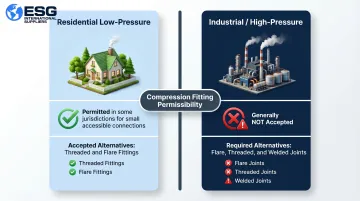
For industrial operations, permanent pressure-rated connections are the standard — not the preference.
Compliance Is Not the Same as Safety
Passing an initial inspection does not mean a fitting is code-compliant or safe long-term. Improperly specified compression fittings may pass initial inspection but create dangerous failure conditions over time due to:
- Vibration from nearby machinery
- Thermal cycling causing ferrule creep
- Inadequate restraint leading to joint separation
Safety Guidelines for Using Compression Fittings on Gas Lines
Where compression fittings are code-permitted on gas lines, safety depends on correct material selection, proper installation, and ongoing vigilance.
General Safety Precautions
Before any work on gas compression fittings:
- Shut off the gas supply and verify zero pressure at the work point
- Use a gas detector to confirm no residual gas before proceeding
- Never work near open flames or ignition sources
- Wear appropriate PPE: safety glasses and gloves minimum; follow facility gas handling protocols in industrial settings
Safety During Installation
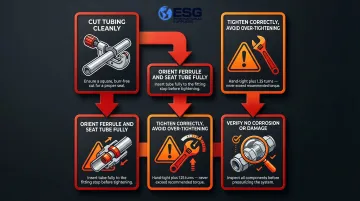
Critical installation steps that affect seal integrity:
- Cut tubing cleanly and squarely with no burrs
- Ensure the ferrule is correctly oriented and the tube is fully seated in the fitting body before tightening
- Avoid over-tightening (which deforms the ferrule and creates leak points)
- Avoid under-tightening (which fails to seat the seal)
Stop work immediately if:
- The fitting or tubing shows corrosion, damage, or dimensional inconsistency
- The fitting is not rated for the gas type and pressure in use
- The location is underground, concealed in a wall, or otherwise inaccessible for future inspection
All gas line work—even on permitted compression fittings—must be completed or supervised by a licensed gas fitter or qualified professional. DIY gas work is illegal in many jurisdictions.
Environmental and System Safety Considerations
Installation quality alone doesn't guarantee long-term seal integrity — the operating environment is an equally critical factor, particularly in industrial, mining, and oil & gas settings.
Conditions that compromise compression fitting performance over time:
- Nearby machinery vibration gradually loosens ferrules, creating incremental leak paths
- Repeated temperature swings cause expansion and contraction that unseat the seal
- Moisture exposure and corrosive atmospheres accelerate ferrule degradation and metal fatigue
Leak testing requirements after any installation:
- Use approved gas leak detection solution or electronic detector—never an open flame
- Check all joints under operating pressure before returning the system to service
- Document test results
When Compression Fittings Are Prohibited on Gas Lines
Underground Installations
Most codes, including NFPA 54, explicitly prohibit mechanical fittings (including compression fittings) in underground gas piping where they cannot be inspected, accessed, or repaired. Underground gas leaks are among the most dangerous and hardest to detect. Natural gas can filter through soil, follow storm drains or water lines, and emerge significant distances from the actual leak site.
Inside Walls, Floors, or Concealed Locations
NFPA 54 Section 7.3.2 restricts concealed fittings to threaded, brazed, welded, or listed press-connect (ANSI LC 4) and CSST (ANSI LC 1) connections—excluding standard compression fittings. Any concealed compression fitting on a gas line is a code violation and a serious safety hazard.
High-Pressure Gas Systems
Compression fittings (particularly standard ferrule-type designs) are not rated for high-pressure gas applications. In industrial oil & gas, power generation, and mining environments, pressure-rated flare or welded connections are required.
Propane (LPG) and Certain Gas Types
Propane systems face stricter fitting requirements than natural gas. Propane is approximately 1.5 times heavier than air, so leaks pool in trenches, basements, and low-lying areas, creating severe explosion hazards.
NFPA 58 sets two pressure thresholds for tube fittings in propane systems:
- Below 125 psig: Fittings must be steel, stainless steel, brass, or anodized aluminum with a design pressure of at least 125 psig
- Above 125 psig: Fittings must be rated for a minimum of 250 psig or the system's design pressure, whichever is greater
Code-Compliant Alternatives and What Fittings Are Approved for Gas Lines
Industry-Approved Fitting Types
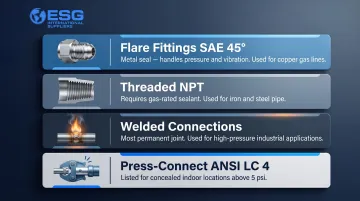
| Fitting Type | Key Characteristic | Common Use Case |
|---|---|---|
| Flare Fittings (SAE 45°) | Metal-to-metal seal; handles pressure and vibration | Copper gas lines where code permits nonferrous tubing |
| Threaded (NPT) | Requires gas-rated thread sealant; NFPA 54 prohibits underground installation | Iron and steel pipe systems |
| Welded Connections | Most permanent, leak-resistant joint available | Indoor systems above 5 psi; high-pressure industrial applications |
| Press-Connect (ANSI LC 4/CSA 6.32) | Listed metallic fittings permitted in concealed locations | Indoor systems operating above 5 psi |
CSST (Corrugated Stainless Steel Tubing)
Of all the alternatives to compression fittings, CSST sees the widest adoption in residential and light commercial work — largely because of its flexibility and faster installation. It requires proper bonding and grounding per code:
- Bonding jumper size: Not smaller than 6 AWG copper wire
- Length limit: 75 feet maximum between gas piping and the grounding electrode system
- Clamp placement: Must attach to rigid pipe component or brass CSST fitting, never directly to corrugated tubing
Industrial Gas Piping Requirements
In industrial settings — oil and gas facilities, power generation plants, large-scale construction — the fitting requirements go beyond what residential codes address. Components must carry applicable certifications: UL listed, CSA approved, and compliant with NFPA 54 at minimum.
For procurement teams sourcing code-compliant fittings and pipe for these applications, ESG International Suppliers stocks flanges, threaded connections, hydraulic fittings, carbon steel pipe, stainless steel pipe, and chrome moly pipe across its industrial distribution catalog. Contact ESG at 516-787-5679 or support@esg_intl.com for specifications and documentation.
Common Safety Mistakes to Avoid
Three mistakes consistently show up in field incidents involving gas-line compression fittings. Each one is preventable with the right knowledge before the job starts.
Assuming Water Fittings Are Gas-Safe
A compression fitting approved for water or hydraulic fluid is not automatically safe for gas. Gas has different leak dynamics, explosion potential, and regulatory requirements. Always verify the fitting's specific gas-service rating and code approval.
The consequences of skipping this step are severe. A 2004 incident in Ramsey, Minnesota, resulted in three fatalities when a coupling designed for steel pipe was incorrectly installed on plastic pipe, with a service tee welded to it contrary to manufacturer recommendations.
Skipping the Leak Test
Gas leaks do not always announce themselves with odor immediately, particularly in outdoor or well-ventilated industrial settings. Every compression fitting installation or reconnection on a gas line must be followed by a proper pressure leak test. A visual inspection alone is not sufficient.
Reusing Ferrules After Disassembly
Compression ferrules deform permanently during initial installation. A reused ferrule cannot create a reliable seal on new tubing. Manufacturers explicitly warn: "Do not reuse ferrules as 'new' parts on new tubing".
To avoid these three failure points on any gas-line job:
- Confirm the fitting carries a gas-service rating before installation
- Conduct a full pressure leak test after every installation or reconnection
- Replace ferrules with new components any time a fitting is disassembled
Conclusion
Compression fittings have a legitimate place on gas lines, but only in narrow, code-defined circumstances. For most applications, a more permanent, pressure-rated connection type is the correct choice — and that default should hold until you've confirmed compatibility with the applicable code and your local AHJ.
Gas line fitting selection isn't a judgment call to make on the fly. Treat it as what it is: a safety-critical decision. That means:
- Consulting a licensed plumber or gas fitter before specifying connection type
- Verifying the fitting material, rating, and installation method against local code
- Scheduling regular inspections to confirm joint integrity over time
The right fitting, installed correctly and verified by a qualified professional, is what keeps a gas system safe long after the job is done.
Frequently Asked Questions
Are compression fittings allowed for natural gas, propane, or LPG lines?
Some jurisdictions permit brass compression fittings for above-ground, low-pressure natural gas in accessible locations. LPG/propane lines typically face stricter restrictions due to propane's higher density. Always verify with local codes and the AHJ before use.
What fittings are approved for gas lines?
Flare fittings, threaded (NPT) connections with gas-rated sealant, welded joints for industrial systems, and CSST where properly installed and bonded are widely accepted—all subject to local code adoption.
What types of fittings are not allowed for gas piping installations?
Most codes prohibit soldered or brazed connections using soft solder, standard compression fittings in concealed or underground locations, and any fitting not rated or approved for the specific gas type and pressure in the system.
When should compression fittings not be used?
Avoid compression fittings underground, in concealed or inaccessible locations, in high-pressure systems, and wherever significant vibration or thermal cycling is present. If local code does not list them as an approved option, treat that as a prohibition.
Can I use a 1/4-inch compression fitting on copper for a gas line?
Possibly — but only where local code explicitly allows it. Confirm the specific fitting size, copper grade, and installation location meet your jurisdiction's requirements with a licensed professional before proceeding.
Which type of copper is not allowed in a gas piping system?
Type M copper is not permitted for gas lines in the U.S. under NFPA 54. Only ACR (air conditioning and refrigeration) copper tubing or Type K/Type L copper may be permitted in some regions. Copper is prohibited if the gas contains more than 0.3 grains of hydrogen sulfide per 100 scf.