
Introduction
Pump failures cost the average offshore operator $38 million in unplanned downtime annually — and worst-performers absorb over $88 million each year. That figure reflects just how central pumps are to oil and gas operations, moving everything from crude oil and drilling mud to chemical additives across the entire production chain.
Most of those failures trace back to the same root cause: the wrong pump for the job. Mismatched equipment leads to cavitation, pressure issues, premature wear, and shutdowns that ripple through production schedules.
The core challenge is fluid-to-technology matching — pairing process fluids that range from clean water and light hydrocarbons to heavy crude, corrosive chemicals, and solids-laden slurries with a pump designed to handle them.
This guide covers the main pump types used across upstream, midstream, and downstream oil and gas operations — how each works and what to consider when selecting one.
Key Takeaways
- Pumps fall into two main categories: kinetic (centrifugal) and positive displacement
- Centrifugal pumps dominate oil and gas, handling high-flow, low-viscosity tasks like crude transport and water injection
- Positive displacement pumps handle high-viscosity fluids, high-pressure service, and precise chemical dosing
- The right pump depends on viscosity, solids content, corrosiveness, required pressure, and flow rate
- Mismatches between pump type and application cause premature failure and higher operating costs
What Are Pumps in the Oil and Gas Industry?
An industrial pump is a mechanical device that transfers fluid from one point to another by adding energy—either through kinetic force or physical displacement. In oil and gas, pumps handle an extraordinary range of duties: circulating drilling mud on rigs, transporting crude through thousands of miles of pipeline, injecting water or chemicals into reservoirs for enhanced recovery, managing produced water, and transferring refined products in downstream processing.
The industry's process fluids span a wide range. On one end: clean water and light hydrocarbons. On the other: heavy crude exceeding 10 million cSt in viscosity, corrosive chemicals requiring specialized materials, and abrasive slurries carrying solids up to 6 inches in diameter. That range demands purpose-built equipment — no single pump design handles all of it reliably.
Key applications include:
- Drilling mud circulation at pressures up to 20,000 psi
- Crude oil pipeline transport across continental distances
- Water injection for secondary recovery in mature fields
- Chemical injection for corrosion and scale control
- Produced water handling with high sand content
- Hydraulic fracturing operations
- Refinery process streams and product transfer
Types of Pumps in the Oil and Gas Industry
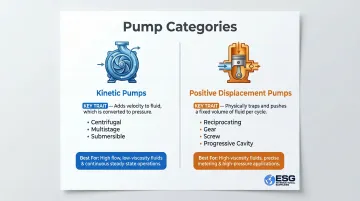
Pumps fall into two fundamental classifications: kinetic pumps (which add velocity to fluid and convert it to pressure) and positive displacement pumps (which physically trap and push fluid through the system). The right choice depends on fluid viscosity, pressure requirements, flow rate, and specific application demands.
Centrifugal Pumps
How it works: Centrifugal pumps use a rotating impeller to add kinetic energy to fluid. As fluid exits the impeller at high velocity, a volute or diffuser converts that velocity into pressure based on Bernoulli's principle. These are the most common pump type in oil and gas, holding an estimated 52% of the global market.
Best suited for: Low-viscosity fluids requiring high flow rates. Typical applications include crude oil shipping, water injection for secondary recovery, pipeline transport, cooling systems, and general fluid transfer. API Standard 610 (12th Edition, 2021) specifies requirements for centrifugal pumps in petroleum, petrochemical, and natural gas process services.
Key strengths:
- Economical purchase and operating costs
- Smooth, continuous discharge flow
- Effective across wide capacity ranges
- Relatively low maintenance compared to positive displacement alternatives
- Simple design with fewer moving parts
Limitations: Efficiency drops significantly with high-viscosity fluids. At viscosities above 600 cP, centrifugal pumps experience severe performance degradation and typically consume 1.2x more power than equivalent positive displacement pumps at 950 cP. Cannot generate the extremely high pressures required for some injection or fracturing applications. Susceptible to cavitation if suction conditions are poor.
Reciprocating Pumps (Plunger and Piston Types)
How it works: Reciprocating pumps use back-and-forth piston or plunger motion inside a cylinder to pressurize fluid. Unlike centrifugal pumps, flow rate stays constant regardless of discharge pressure—making them true constant-flow devices. A pressure relief valve is always required on the discharge line.
Plunger pumps (with thicker plungers versus piston disks) can handle significantly higher pressures and are less prone to buckling.
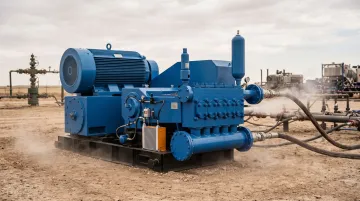
Best suited for: High-pressure applications such as hydraulic fracturing, wellbore injection, pipeline pressure boosting, descaling operations, and saltwater disposal. Modern frac pumps deliver up to 2,700 hydraulic horsepower at operating pressures of 20,000 psi. Also used as direct-acting steam-driven pumps in certain configurations.
Limitations: Produce pulsating flow at discharge, typically requiring a pulsation dampener per API 674 standards. Higher maintenance demands than centrifugal pumps due to valves, seals, and moving parts that wear under high-pressure cycling. Louder operation. Not economical for high-flow-rate, low-pressure scenarios where centrifugal pumps excel.
Rotary Pumps (Gear and Screw Types)
Gear pumps: Use meshing external or internal gears to trap fluid in tooth gaps and carry it around the casing to discharge. They deliver smooth, constant flow and are best suited for clean, viscous fluids such as lubricating oil, hydraulic fluid, and fuel oil. Because fluid passes through tight gear clearances, abrasive or particle-laden fluids cause rapid wear. Flowserve GA Series gear pumps, for example, handle viscosities up to 50,000 SSU and pressures to 250 psi.
Key traits for gear pump selection:
- Best for clean, viscous fluids (lube oil, hydraulic fluid, fuel oil)
- Delivers smooth, constant flow without pulsation
- Vulnerable to rapid wear from abrasive or particle-laden fluids
- Relatively lower pressure ceiling (250 psi typical)
Screw pumps: Use one, two, or three threaded screws turning in a fixed casing to move fluid axially. They produce less noise, vibration, and pulsation than gear pumps and can handle higher rotational speeds. Twin-screw multiphase pumps can handle up to 100% Gas Void Fraction (GVF), allowing operators to boost untreated well streams containing mixtures of oil, water, and gas without prior separation facilities. This makes twin-screw pumps increasingly common in multiphase applications, particularly for brownfield development and heavy crude transport.
Limitations: Gear pumps are limited to clean fluids and relatively lower capacities. Screw pumps have higher initial costs and are sensitive to fluid contamination. Both rotary types require pressure relief valves on discharge lines.
Progressive Cavity Pumps
Progressive cavity (PC) pumps use a helical rotor turning inside a stator to create a series of discrete, sealed cavities that move fluid from suction to discharge. Flow rate stays relatively constant regardless of pressure, though some slippage occurs at higher pressures.
These pumps are purpose-built for demanding fluid conditions: high-viscosity fluids, solids-laden or abrasive slurries, produced water with sand content, and applications where mixing or shearing must be avoided. PC pumps handle viscosities up to 10 million cSt and solid sizes up to 6 inches. They're also common in wastewater treatment and sludge transfer.
Bear in mind that flow slippage increases at higher pressures, stator material must be chemically compatible with the pumped fluid, and relief valves are required. For clean, low-viscosity fluids, centrifugal pumps remain the more economical choice.
Diaphragm and Metering Pumps
Diaphragm pumps use a flexible diaphragm—often PTFE or other chemically resistant material—actuated by a piston or plunger to move fluid. Because fluid contacts only the diaphragm and valves (not mechanical drive components), they handle corrosive, toxic, or chemically aggressive fluids safely. Widely used in dosing, chemical injection, and acid-handling applications in O&G.
Metering pumps describe an application (precise, adjustable flow delivery) rather than a single pump design. Most use diaphragm or packed plunger liquid ends and are essential in upstream and midstream operations for adding exact quantities of corrosion inhibitors, methanol, and scale inhibitors to process streams. API 675 (3rd Edition, 2012) requires flow repeatability within ±3% of rated capacity.
Both types are limited to relatively low flow capacities. Diaphragm pumps can experience brief low-pressure interruptions and aren't suitable for continuous high-pressure or long-distance service. Metering accuracy drifts if pumps aren't regularly calibrated or if back-pressure changes.
How to Choose the Right Pump for Your Oil and Gas Application
The right pump is determined by specific application demands—fluid type, system pressure, flow rate, and environment—not by what's most familiar or widely available. Mismatches between pump type and application are a leading cause of premature equipment failure and contribute significantly to the $38 million average annual downtime cost.
Fluid Properties
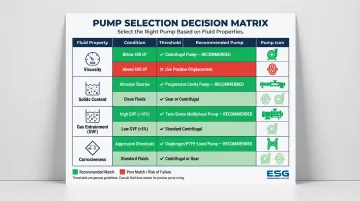
Viscosity is the primary driver. Centrifugal pumps work best below 400 cP, experience significant efficiency loss between 400–600 cP, and are generally unsuitable above 600 cP. Positive displacement pumps are preferred for higher viscosities. Also consider:
- Solids content - Progressive cavity pumps handle abrasive slurries; centrifugal pumps with particle-laden fluids wear rapidly
- Gas entrainment - Twin-screw multiphase pumps can handle up to 100% GVF; standard centrifugals cannot
- Corrosiveness - Diaphragm pumps with PTFE components excel for aggressive chemicals
Required Pressure and Flow Rate
Centrifugal pumps excel at high flow rates but are limited in pressure head generation. Positive displacement pumps generate extremely high pressures (up to 20,000 psi for frac pumps) but at lower, fixed flow rates. Map your application's pressure-flow curve against pump performance curves before committing to a selection.
Stage of Operation
- Upstream — High-pressure reciprocating pumps for drilling and wellbore injection; metering pumps for chemical injection
- Midstream — Centrifugal or screw pumps for pipeline transport; twin-screw designs for multiphase flow
- Downstream — Diaphragm and metering pumps for refinery chemical handling; centrifugal pumps for product transfer
Maintenance Requirements and Total Cost of Ownership
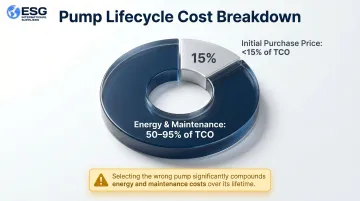
Purchase price is rarely the biggest cost. According to IPIECA, over a pump's lifetime:
- Energy and maintenance account for 50–95% of Total Cost of Ownership
- Initial purchase price represents less than 15%
Centrifugal pumps generally offer lower maintenance needs and longer service intervals. Positive displacement pumps are more capable in demanding conditions but require more frequent inspection of valves, seals, and wear parts.
ESG International Suppliers stocks centrifugal, submersible, progressive cavity, and diaphragm pumps from manufacturers including WEG, Siemens, Baldor, and Marathon. Working with a knowledgeable distributor early in the procurement process helps match the right pump to your specific operating conditions — before a mismatch becomes a maintenance problem.
Common Mistakes to Avoid When Selecting an Oil and Gas Pump
Even experienced engineers make costly pump selection errors. These three mistakes account for a disproportionate share of underperforming installations and premature failures in oil and gas applications.
- Over-specifying pressure capability: Choosing a high-pressure positive displacement pump for a moderate-pressure application inflates capital cost, adds maintenance complexity, and can create operational problems. Match pump capability to actual system requirements — not theoretical maximums.
- Overlooking fluid characteristics: Viscosity, solids content, gas entrainment, and chemical corrosiveness must all factor into the selection process. Deploying a centrifugal pump on high-viscosity or solids-laden fluid leads to underperformance, cavitation, or early failure. Approximately 33% of pump failures involve bearing distress — frequently traced back to mismatched application.
- Defaulting to familiar pump types: Procurement teams sometimes reuse past selections even when a different pump type would better fit the job. Each application's conditions — fluid properties, pressure, flow rate, environment — should be evaluated independently against pump performance characteristics.
Conclusion
Pumps are foundational to each phase of oil and gas operations, from drilling to refining. No single pump type serves all applications—centrifugal pumps dominate high-flow, low-viscosity scenarios, while positive displacement types cover high-pressure, high-viscosity, and precision dosing needs.
Matching the right pump to specific fluid conditions, pressure requirements, and operational context is what separates efficient operations from costly downtime. With energy and maintenance accounting for up to 95% of lifecycle costs, the selection decision carries real financial weight. A few principles guide that decision:
- Match pump type to fluid viscosity and flow rate requirements first
- Prioritize pressure ratings and seal compatibility for upstream applications
- Factor in total lifecycle cost, not just purchase price
- Confirm the supplier can source across pump categories for your full project scope
ESG International Suppliers stocks centrifugal, submersible, progressive cavity, and diaphragm pumps suited to O&G operations across North and South America. Their team can help match equipment to your application and keep your project on schedule.
Frequently Asked Questions
What are the different types of pumps used in the oil and gas industry?
The industry uses two main categories: kinetic (centrifugal) and positive displacement pumps. Specific types include centrifugal, reciprocating plunger/piston, gear, screw, progressive cavity, and diaphragm/metering pumps, each optimized for different fluid properties and operating conditions.
Which type of pump is most commonly used in the oil and gas industry?
Centrifugal pumps are the most common, holding approximately 52% of the global oil and gas pump market. Their versatility and ability to handle large volumes of low-viscosity fluids at low cost make them the default choice across upstream, midstream, and downstream applications.
What kind of pumps do oil rigs use?
Oil rigs primarily use reciprocating plunger/piston pumps — called mud pumps — to circulate drilling fluid at pressures up to 20,000 psi. Centrifugal pumps handle general fluid transfer, while diaphragm or metering pumps manage precise chemical injection into the wellbore.
What are crude oil pumps called?
Crude oil pumps are typically called pipeline pumps or crude transfer pumps. Operators typically use centrifugal pumps for lighter crude and progressive cavity or screw pumps for heavier, more viscous crude exceeding 400–600 cP.
Can a drill pump be used for oil?
Drill pumps (reciprocating plunger pumps designed for drilling mud circulation) can handle crude oil but are not optimized for continuous transfer applications. Purpose-built crude transfer or pipeline pumps are more efficient and cost-effective for oil transport operations.
What is P1 and P2 on a pump?
P1 refers to the inlet (suction) pressure and P2 refers to the outlet (discharge) pressure. The difference between P2 and P1 represents the pressure rise the pump adds to the fluid, which is a key parameter in pump selection and system design.