Introduction
When a pipeline fails or an isolation valve leaks in an oil and gas facility, the cost isn't just the price tag of the component—it's the $1 million per hour in downtime that brings production to a standstill. In automotive plants, that figure climbs to $2.3 million per hour. For engineers specifying valves across power generation, mining, and chemical processing, that exposure makes every component decision consequential.
Butterfly valves and ball valves are both quarter-turn rotary designs governed by API standards, but they are not interchangeable. Their differences in pressure handling, seal integrity, and flow characteristics are significant enough that specifying the wrong type can lead to premature failure, system inefficiency, and unplanned shutdowns. This guide breaks down exactly where each valve excels—and where it doesn't.
Key Takeaways
- Ball valves use a rotating sphere; butterfly valves use a flat disc—same quarter-turn operation, very different performance
- Ball valves excel at high-pressure service (6,000+ PSI for trunnion designs), zero-leakage shutoff, and pigging compatibility
- Butterfly valves are the better choice at larger diameters (6"+ / DN150+)—typically 40-70% cheaper and 70-75% lighter than equivalent ball valves
- Choosing between them comes down to pressure rating, pipe diameter, seal requirements, media type, and total installed cost
- Neither valve wins outright—the right choice depends entirely on your application
Butterfly Valve vs Ball Valve: Quick Comparison
Use this table as a fast reference before diving into the detailed breakdown below.
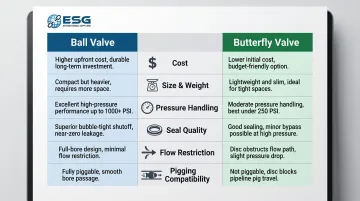
| Criteria | Ball Valve | Butterfly Valve |
|---|---|---|
| Cost | More economical below DN 100 / 4". Costs rise steeply with size due to solid ball construction and complex machining. | More economical at DN 100 and above. Fewer parts reduce upfront and maintenance costs. At 6" and larger, typically 40–70% cheaper than equivalent ball valves. |
| Size & Weight | Heavier due to solid ball construction. May require additional pipe support at larger sizes. | Typically 70–75% lighter than equivalent ball valves. Compact wafer/lug design simplifies handling and requires less installation space. |
| Pressure Handling | Rated for high-pressure service. Trunnion-mounted designs reach ASME Class 2500 (6,000+ PSI). Bypass valves recommended to protect seats during opening under high upstream pressure. | Concentric designs limited to 250–285 PSI. Triple-offset variants reach Class 600–1500 (1,480+ PSI) at higher cost. High differential pressure makes the disc harder to open and increases leakage risk. |
| Seal Quality | Bubble-tight, zero-leakage shutoff per API 598. Upstream pressure pushes ball against seat for a positive seal. Preferred for gas lines and critical isolation. | Reliable seal at low pressure. Concentric resilient seats are more prone to leakage at higher pressures. Triple-offset metal-seated designs approach ball valve performance at premium cost. |
| Flow Restriction | Full-port designs match pipe bore — zero pressure drop. Reduced-port creates minimal restriction. | Disc stays in the flow path when fully open, producing measurable pressure drop. Turbulence occurs around the disc and shaft in all configurations. |
| Pipeline Pigging | Full-bore designs support pigging per API 6D — cleaning devices pass through unobstructed. | Central shaft and disc obstruction makes butterfly valves incompatible with pigging operations. |
What is a Ball Valve?
A ball valve is a quarter-turn valve that controls flow using a hollow, perforated sphere (the "ball") rotated 90° via a stem and handle or actuator. When the bore aligns with the pipe, flow passes through freely; when perpendicular, flow is completely blocked. This simple, reliable mechanism makes ball valves essential for high-demand industrial environments where tight shutoff and operational reliability are required.
Design Variations
| Variant | Performance Characteristics |
|---|---|
| Full-Port (Full-Bore) | Bore matches pipeline internal diameter—creates continuous, unobstructed path with zero pressure drop. Essential for pigging operations. |
| Reduced-Port | Smaller bore than connecting pipeline—creates flow restriction and higher pressure drop. Used where space/weight constraints exist. |
| V-Port | V-notched ball provides shearing action and proportional flow control—ideal for precise modulating and throttling applications. |
| Trunnion-Mounted | Ball anchored top and bottom—absorbs line pressure and reduces operating torque. Essential for high-pressure (6,000+ PSI) and large-diameter applications. |
| Floating Ball | Ball pushed against downstream seat by line pressure—torque increases exponentially at higher pressures. Typically limited to smaller sizes and pressures under 1,480 PSI. |
Body Configurations and Maintenance Impact
Body design directly affects maintenance accessibility:
- 1-Piece: Solid cast body—lowest cost but cannot be repaired inline
- 2-Piece: Two bolted sections—requires pipeline removal for maintenance
- 3-Piece: Removable center section—allows inline replacement of seats and seals without disturbing pipe alignment, minimizing downtime
The 3-piece design is preferred for maintenance-intensive systems where reducing downtime is critical.
Core Performance Advantages
Body design determines maintainability — but it's the operating performance that makes ball valves the preferred choice in demanding systems:
- Zero-leakage shutoff: API 598 and ISO 5208 set the standard. For soft-seated designs, API 598 mandates "0 drops" for liquids and "0 bubbles" for gas — making ball valves the default for gas lines and any safety-critical isolation.
- High-pressure reliability: Ball valves handle high upstream pressure reliably. For trunnion-mounted designs, always equalize pressure via a bypass valve before opening — differential loading at full pressure can damage seats.
- Media versatility: Handles both liquid and gas, including corrosive chemicals and abrasive slurries. The self-wiping action during rotation resists buildup.
- Pigging compatibility: Full-bore ball valves comply with API 6D, making them suitable for pipeline pigging operations in oil and gas transmission.
Use Cases of Ball Valves
Ball valves dominate applications where failure carries severe consequences:
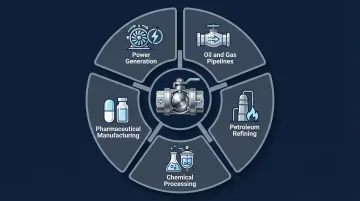
- Oil & Gas Pipelines: High-pressure shutoff, wellhead isolation, transmission lines requiring pigging
- Petroleum Refining: Fractionators, high-pressure process loops, catalyst handling
- Chemical Processing: Corrosive media requiring tight seals and zero-leakage isolation
- Pharmaceutical Manufacturing: Cavity-filler variants prevent contamination; stainless steel sanitary designs meet FDA/3-A compliance requirements (accounting for 29% of ball valve demand)
- Power Generation: High-pressure steam lines, boiler feed systems
Ball valves are the preferred choice when system failures carry high safety or operational risk, or when frequent on/off cycling is required without seal degradation.
What is a Butterfly Valve?
A butterfly valve is a quarter-turn valve that controls flow using a flat circular disc mounted on a central stem. When open, the disc rotates to align edge-on with the flow, minimizing obstruction; when closed, the disc face blocks flow entirely. This compact, lightweight design makes butterfly valves the standard for large-diameter, high-volume flow systems where cost efficiency matters.
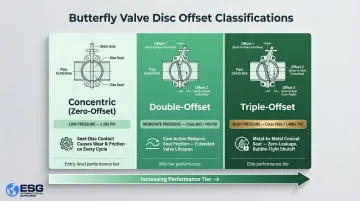
Disc Offset Classifications (API 609)
| Design | API 609 Category | Mechanics & Performance |
|---|---|---|
| Concentric (Zero-Offset) | Category A | Stem and disc centered—constant interference contact with rubber seat. Low cost, low pressure (<285 PSI). Prone to wear from friction. Standard for water/HVAC. |
| Double-Offset | Category B | Stem offset from disc and pipe center—creates cam action lifting disc off seat quickly. Reduces wear, handles higher pressures and temperatures. |
| Triple-Offset (TOV) | Category B | Adds conical seating surface—eliminates rubbing during entire stroke. Metal-to-metal seating achieves bidirectional zero-leakage (API 598). Handles extreme conditions (Class 1500 / 1,480+ PSI). |
Triple-offset butterfly valves close much of the performance gap with ball valves—high-pressure capability, near-zero leakage—but at a cost well above standard butterfly designs.
Mounting Designs
Two body configurations determine how the valve integrates into your piping system:
- Wafer type: Sandwiched between pipe flanges and held by through-bolts. Space-saving and economical, but removal requires depressurizing and separating both sides of the pipeline.
- Lug type: Threaded metal inserts allow independent bolting to each flange. Downstream piping can be removed without shutting down the upstream system — better for maintenance-intensive installations.
Core Performance Advantages
These design characteristics translate into concrete field advantages:
- Weigh 70-75% less than equivalent ball valves, with a smaller footprint — a real factor in large-diameter or weight-sensitive installations
- Deliver 40-70% cost savings at 6-inch diameters and above (material and installation combined)
- Open and close with a single quarter-turn and minimal torque in low-pressure service
- Contain no internal cavities where media can pool — an important consideration for sanitary and food-grade lines
- Support Clean-In-Place (CIP) and Steam-In-Place (SIP) sterilization per EHEDG and 3-A standards on sanitary models
Use Cases of Butterfly Valves
Butterfly valves dominate applications where large volume, lower pressure, and cost efficiency are priorities:
- Municipal Water Distribution and Wastewater Treatment: Large-diameter flow control (accounts for 37.5% of butterfly valve market revenue)
- HVAC Systems: Cooling water lines, commercial building climate control
- Agricultural Irrigation: High-volume water delivery at moderate pressures
- Food and Beverage Processing: Sanitary tri-clamp butterfly valves with FDA-compliant elastomers
- Chemical Plant General Service: Large-bore lines where some pressure drop is acceptable
Critical Limitation: Butterfly valves are not suitable for applications requiring zero leakage, pigging compatibility, or pressures consistently above 250 PSI (for concentric designs)—substituting a butterfly valve for a ball valve in these contexts introduces risk, not savings.
Butterfly Valve vs Ball Valve: Which One is Right for Your Application?
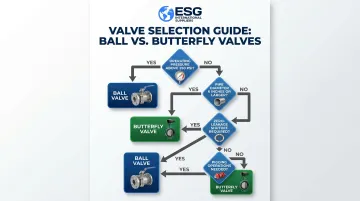
The right valve choice hinges on five critical factors:
- Operating pressure range
- Pipe diameter
- Media type and cleanliness
- Seal reliability requirements
- Lifecycle cost vs. upfront budget
Use these factors as your decision framework — the sections below map each scenario to the valve type that fits.
Choose a Ball Valve When:
- Operating pressure exceeds 250 PSI (for standard service) or requires high-pressure capability up to 6,000+ PSI
- Zero-leakage shutoff is non-negotiable (gas lines, chemical systems, pharmaceutical processes)
- The system requires pigging for cleaning or inspection
- Pipe diameter is under 6" (DN 150) where ball valves remain cost-competitive
- Media includes both liquids and gases, or involves abrasive/corrosive materials requiring robust sealing
- Application is in oil & gas, refining, or power generation where failure consequences are severe
- Frequent cycling is required without seal degradation
Choose a Butterfly Valve When:
- Pipe diameter is 6" or larger and weight/space constraints apply
- System operates at 250 PSI or below (concentric designs) or up to 1,480+ PSI (triple-offset designs at higher cost)
- Media is water-based, slurry, or non-abrasive liquid without suspended solids that could damage the disc
- Budget is a primary constraint on large-scale installations
- Application is in municipal water treatment, construction water systems, or power generation cooling circuits
- Zero-leakage shutoff is not critical
- Pigging operations are not required
Mid-Range Systems: Making the Call
For systems in the DN 100–150 range with moderate pressure and mixed media, the decision should weigh long-term seal reliability and maintenance costs against upfront savings. Consider:
- Will seal degradation create operational risk or safety issues?
- Does the media contain particulates that could damage butterfly valve seats?
- Is the pressure differential high enough to complicate butterfly valve operation?
- What are the lifecycle maintenance costs for each option?
Consulting an industrial supplier with application-specific expertise can prevent costly misspecification. ESG stocks both ball and butterfly valves sourced from established manufacturers, and their technical team works directly with engineers in oil & gas, power generation, mining, and construction to match valve specs to system demands. Reach ESG at 516-787-5679 or support@esg_intl.com to discuss your application.
Conclusion
There is no universal winner in the butterfly valve vs. ball valve decision. Ball valves earn their place where pressure integrity, tight shutoff, and long-term seal reliability are non-negotiable. Butterfly valves make more sense when cost efficiency, compact installation footprint, and high-volume flow at low-to-medium pressure drive the specification.
The right valve is the one matched to your system's specific demands. Key factors to weigh before finalizing any selection:
- Operating pressure and temperature — ball valves handle extremes; butterfly valves suit moderate ranges
- Pipe diameter — butterfly valves become significantly more economical above 6 inches
- Media characteristics — slurries, solids, and corrosives narrow the field quickly
- Consequence of failure — higher-risk applications justify the cost premium of a ball valve
Getting the specification right the first time reduces unplanned downtime, extends service life, and keeps operations running. For industrial procurement teams sourcing across construction, oil and gas, mining, or power generation, that precision at the selection stage is where the real cost savings begin.
Frequently Asked Questions
Which is better, a ball valve or a butterfly valve?
Neither is universally better. Ball valves excel in high-pressure, tight-seal applications where zero-leakage shutoff is required. Butterfly valves are more cost-effective for large-diameter, lower-pressure systems. The right choice depends on your operating pressure, pipe size, and fluid type.
What is the most reliable valve type?
Ball valves deliver more reliable performance in demanding applications, thanks to their bubble-tight seal and consistent behavior under high pressure. That said, high-quality double or triple-offset butterfly valves offer strong reliability when matched to appropriate service conditions.
Can butterfly valves handle high pressure?
Standard concentric butterfly valves are typically rated for 250-285 PSI or less. High differential pressure makes the disc difficult to open and increases leakage risk. Triple-offset, metal-seated butterfly valves can handle higher pressures (Class 600-1500 / 1,480+ PSI) but come at a significantly higher cost and are engineered for specific high-pressure service.
Are ball valves more expensive than butterfly valves?
Ball valves cost less at smaller pipe diameters (below DN 100) but increase significantly with size due to solid ball construction and machining complexity. Butterfly valves become the more economical choice at larger diameters, often offering 40-70% cost savings on materials and installation.
What is the main disadvantage of a butterfly valve?
The disc stays in the flow path at all times. This creates measurable pressure drop even when fully open, blocks pigging operations, and reduces reliability under high-pressure differentials — none of which are issues with a full-port ball valve.
Can a butterfly valve be used for gas applications?
Standard concentric butterfly valves are not recommended for gas applications where zero-leakage shutoff is required. Their disc design makes a perfect seal difficult to guarantee at higher pressures, and leakage can create safety hazards. Ball valves are the standard choice for gas lines due to their positive shutoff capability.