Introduction
Across oil and gas pipelines, power plants, water treatment facilities, and chemical processing systems, butterfly valves handle one of the most basic—and critical—jobs in fluid control. These quarter-turn devices use a rotating disc to start, stop, or throttle flow with a single 90-degree motion, making them one of the most common valve types in industrial piping.
Not all butterfly valves are the same. They differ significantly by disc design, seat material, and connection style, and selecting the wrong type can cause leakage, premature wear, or system failure that costs time and money in heavy industry environments.
This guide covers the main types of butterfly valves across three classification dimensions, what each type is best suited for, and how to choose the right one for your application.
Key Takeaways
- Butterfly valves control fluid flow using a rotating disc—compact, cost-effective, and widely used across heavy industries
- They're classified three ways: disc offset design (concentric, double-offset, triple-offset), seat material (soft vs. metal), and connection style (wafer, lug, flanged)
- Concentric designs suit low-pressure service; double-offset handles moderate-to-high pressure; triple-offset handles extreme temperatures and zero-leakage shutoff
- Seat material drives chemical compatibility and leakage class; connection style determines installation flexibility and dead-end service capability
- Choosing the right type requires matching valve specs to fluid type, pressure rating, temperature range, and pipeline configuration
What Is a Butterfly Valve and Why Does It Matter?
A butterfly valve is a flow regulation device consisting of a metal disc mounted on a rotating stem. The disc opens and closes with a 90-degree quarter-turn motion—parallel to flow when open, perpendicular when closed.
Common applications include:
- Oil and gas pipelines
- Water and wastewater treatment plants
- Power generation facilities
- Chemical processing operations
- Mining slurry transport
- HVAC systems
Their compact size, fast quarter-turn operation, and lower cost compared to gate or globe valves make them a go-to across these industries. Demand reflects this: the global butterfly valve market reached $11.3 billion in 2024 and is projected to grow to $18.4 billion by 2034.
That growth also comes with higher stakes for selection. The wrong valve type leads to seat wear, leakage, system inefficiency, or sudden failure in high-pressure environments—which is why understanding the differences between valve types matters before specifying one.
Types of Butterfly Valves by Disc Design
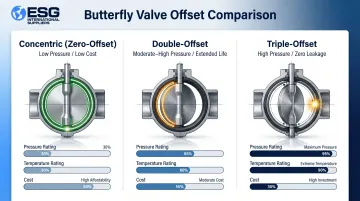
Disc design—also called "offset" configuration—is the most fundamental classification. It determines sealing performance, pressure rating, temperature tolerance, and operational wear.
"Offset" refers to how the stem and sealing geometry are positioned relative to the disc center and pipe bore. Greater offset delivers better sealing with less friction—and the three designs below represent three distinct tiers of performance, cost, and application fit.
Concentric (Zero-Offset) Butterfly Valves
The stem passes directly through the center of the disc and pipe bore with no offset. When closing, the disc presses into a soft (rubber or PTFE) seat, creating a seal through full compression contact throughout the entire 90-degree rotation.
Distinguishing factor: The constant seat contact during operation causes friction and wear, shortening service life. This is the simplest and most affordable design.
Best suited for:
- Low-pressure, low-temperature applications
- Water distribution systems
- HVAC installations
- Food processing lines
- General industrial systems where cost efficiency outweighs longevity demands
Strengths: Lowest cost, easy to source and replace, available in wide size ranges, effective for basic on/off isolation in non-aggressive media.
Double-Offset (Double Eccentric) Butterfly Valves
The stem is positioned behind and to the side of the disc centerline, creating two geometric offsets. This causes the disc to lift away from the seat immediately upon opening, reducing contact and friction.
Key trade-off: Unlike the concentric design, the disc only contacts the seat in the final 1–3 degrees of closing. This sharply cuts wear and allows metal or soft seats—extending service life and raising pressure capability.
Best suited for:
- Moderate-to-high pressure applications
- Water pipelines
- Oil and gas midstream systems
- Power generation facilities
- Applications requiring longer service intervals
Strengths: Longer seat life, reduced operating torque, suitability for both metal and resilient seats. Trade-off: costs more than zero-offset designs.
Triple-Offset (Triple Eccentric) Butterfly Valves
Adds a third geometric offset—the sealing surface is machined as a cone shape rather than a flat face. The disc and seat make contact only at the final point of closing, with zero rubbing throughout the entire operating cycle.
Why it's different: The conical seat geometry achieves metal-to-metal, zero-leakage sealing with virtually no seat or disc wear. The valve becomes torque-seated (position-held by pressure) rather than position-seated. A technical overview by Tomoe details how the conical geometry eliminates premature wear across high-cycle service.
Best suited for:
- High-pressure, high-temperature applications
- Cryogenic service
- Steam lines
- Chemical pipelines
- Fire-safe services
- Nuclear containment
- Any system requiring frequent actuation with zero leakage tolerance
Strengths: Superior sealing performance, extremely long cycle life, bidirectional sealing, compatibility with aggressive media. Trade-offs: higher cost, heavier construction, more complex installation—reserved for critical service environments where performance requirements justify the investment.
Types of Butterfly Valves by Seat Material
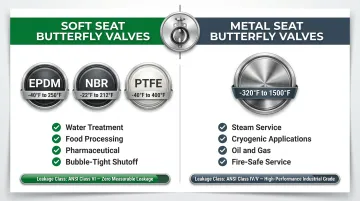
Seat material determines chemical compatibility, maximum operating temperature, allowable leakage rate, and replacement frequency. This classification ties directly to disc design: concentric valves use soft seats, and triple-offset valves use metal seats.
Soft-Seated (Rubber or PTFE-Lined) Butterfly Valves
The sealing surface is made from non-metallic materials such as EPDM, nitrile rubber, or PTFE. These materials deform slightly under compression, creating a leak-free seal.
| Seat Material | Temperature Range | Applications |
|---|---|---|
| EPDM | -20°F to 250°F | Dilute acids, alkalies, alcohols—not for hydrocarbon service |
| NBR (Buna-N) | 0°F to 212°F | Hydrocarbon service, oils, fuels |
| PTFE | 0°F to 400°F | Exceptional chemical resistance, aggressive media |
Best suited for applications where zero leakage is required and temperatures stay moderate:
- Water treatment and municipal systems
- Food and beverage processing
- Pharmaceutical manufacturing
- General chemical service
Soft seats are also easier and cheaper to replace than metal alternatives.
Metal-Seated Butterfly Valves
Both the disc and seat sealing surfaces are machined metal (stainless steel, Inconel, or other alloys). This allows the valve to withstand corrosive media, high heat, and elevated pressures.
Unlike soft-seated designs, metal seats allow some leakage within accepted limits — such as API Class IV/V — rather than achieving a bubble-tight shutoff. Metal-seated valves typically operate from -320°F to 1500°F.
Best suited for demanding conditions where soft seats would degrade:
- High-temperature steam and thermal systems
- Fire-safe and cryogenic service
- Oil and gas processing environments
- Power generation and mining applications
Types of Butterfly Valves by Body Connection Style
Body connection style determines how the valve physically attaches to the pipeline, affecting installation cost, maintenance access, pressure handling, and whether the valve can be used at the end of a line.
Wafer Style
The valve body sits sandwiched between two pipe flanges and is held in place by long bolts that pass through both flanges on either side of the valve body. No bolts thread into the valve itself. This produces the most compact and lowest-cost connection option.
Best suited for: In-line service (not end-of-line), space-constrained systems, and budget-sensitive applications.
Critical limitation: Wafer valves are strictly prohibited from dead-end (end-of-line) service. The entire pipeline must be shut down for valve removal.
Lug Style
The valve body has threaded inserts (lugs) that project outward from its exterior. Each flange bolts directly into these lugs with its own bolt set, allowing one side of the pipe to be disconnected without removing the other.
Best suited for: Dead-end or end-of-line service, and systems requiring easy removal of one pipe section for maintenance.
Important consideration: Some manufacturers derate lug valves when installed without a mating flange supporting the retainer ring—for example, Flowserve derates certain lug valves to 150 PSI maximum in unsupported dead-end configurations.
Flanged (Double-Flanged) Style
Flanged faces are integral to both sides of the valve body, bolting directly to matching pipe flanges. This produces the most stable, rigid connection, common in large-diameter valves and higher-pressure systems.
Best suited for: Large valve sizes, high-pressure pipelines, and applications where structural rigidity and visual inspection of both connection faces are important, such as water treatment plants and industrial pipelines.
Key consideration: Flanged valves carry higher installation costs and a larger face-to-face dimension than wafer or lug styles.
How to Choose the Right Butterfly Valve
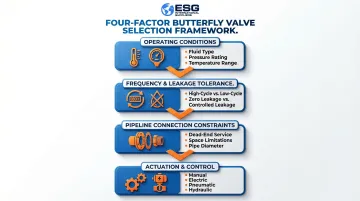
The right butterfly valve type is determined by matching application-specific requirements—not by cost or brand familiarity alone. The same pipeline may need a triple-offset metal-seated valve in one section and a concentric soft-seated valve in another.
Operating Conditions
Identify three critical factors:
- Fluid type: Water, chemical, gas, or slurry
- Pressure rating: In PSI or PN class
- Operating temperature range: From minimum to maximum expected
These three factors narrow disc design and seat material choices considerably.
Frequency of Operation and Leakage Tolerance
High-cycle applications: Frequent open/close operations demand double- or triple-offset designs to avoid rapid seat wear.
Leakage requirements:
- Applications requiring zero leakage (clean water, food-grade, pharmaceutical) should specify soft-seated valves
- Applications tolerating minor controlled leakage under extreme conditions may accept metal seats per API standards
Pipeline Connection Constraints
Determine:
- Whether the valve must serve as a dead-end unit (requiring lug or flanged style)
- Whether space is limited (favoring wafer or lug)
- Whether the system uses large-diameter piping (often requiring double-flanged construction)
Actuation and Control Needs
Consider whether the valve will be operated manually, remotely via electric actuator, or automatically via pneumatic or hydraulic actuator. Valve torque requirements vary drastically based on media—dry, non-lubricating gases or abrasive powders require higher torque safety factors compared to clean, lubricating liquids.
Working with ESG International Suppliers
ESG International Suppliers works with procurement and engineering teams across oil and gas, power generation, mining, and construction to match butterfly valve specifications to exact operating conditions — reducing the risk of premature failure or unnecessary over-specification.
Contact their technical team directly:
- Phone: 516-787-5679
- Email:
support@esg_intl.com
Frequently Asked Questions
Which butterfly valve is best?
There is no single "best" butterfly valve—the right type depends on operating pressure, temperature, fluid type, and leakage tolerance. Triple-offset metal-seated valves excel in harsh conditions, while concentric soft-seated valves are sufficient for standard, low-pressure service.
What are the different types of butterfly valves?
Butterfly valves are classified three ways: by disc design (concentric, double-offset, triple-offset), by seat material (soft-seated vs. metal-seated), and by body connection style (wafer, lug, double-flanged). Valves are often described using a combination of these classifications.
What is a U type butterfly valve?
A U-type (or U-section) butterfly valve refers to a flanged butterfly valve with a U-shaped body profile, where two integral flanges on either side connect directly to the pipeline. The two flanges are not always perfectly parallel, which can create bolting alignment issues during installation.
What applications are butterfly valves used for?
Butterfly valves handle on/off isolation and throttling across a wide range of services: water distribution, cooling systems, oil and gas pipelines, chemical processing, power plant steam and condensate lines, HVAC, and mining slurry transport.
What industries use butterfly valves?
Key industries include oil and gas, power generation, water and wastewater treatment, chemical and pharmaceutical processing, food and beverage, mining, and HVAC. Their compact footprint and quick operation make them a cost-effective alternative to gate or globe valves in these applications.
What is the difference between a wafer and lug butterfly valve?
Wafer valves are held between two flanges by through-bolts and cannot be used in dead-end service. Lug valves have threaded inserts that allow each flange to bolt independently—making lug valves suitable for end-of-line use and enabling one side of the piping to be removed without disturbing the other.